
How Do You Know if You Have a Slab Leak? 5 Signs to Catch Early
You notice the water bill jumped again, but nobody used more water than usual. Or maybe there's a patch of flooring that's always a little warmer than the rest of the room, for no reason you can explain. Neither one looks like a plumbing emergency. Both can be the only warning you get before a leak running under your foundation turns into a much bigger repair.
A slab leak is a leak in a water line that runs underneath a concrete foundation slab rather than through a wall or under a sink. Because the pipe is buried in and under structural concrete, the leak doesn't show up the way a burst supply line under a sink does. There's no drip to find, no wet cabinet floor, no obvious source to trace. Instead, the signs show up secondhand, in the water bill, in the floor itself, in a sound you only notice when the house is quiet. Learning to read those signs is the difference between catching a slab leak early and discovering it when a section of flooring buckles.
Why Slab Leaks Are Harder to Catch Than Other Leaks
A leak under a sink or behind a washing machine leaves evidence near where it occurs. Water pools, cabinets swell, a stain spreads across drywall. A slab leak has none of that immediate feedback, because the pipe sits inside or beneath a poured concrete foundation, often several inches of concrete and soil between the leak and anything you can see or touch.
Water escaping under a slab does one of two things: it finds the path of least resistance through the soil and works its way up around the foundation, or it stays trapped beneath the concrete and slowly saturates the soil beneath the house. Either way, by the time moisture actually reaches a visible surface, the leak has usually been running for a while. Slab-on-grade construction over expansive clay soils makes this worse, since soil that swells and shifts with moisture changes can stress a buried pipe in the first place and then trap the water that leaks out, hiding the problem even longer.
That delay is exactly why the signs below matter. None of them prove a slab leak on their own, but together, they're the earliest window you have before the damage becomes structural instead of just plumbing.
Your Water Bill and Meter Are Telling You Something
A rising water bill with no obvious cause is one of the most reliable early flags. If nobody added a garden, filled a pool, or ran extra loads of laundry, and the bill still climbed, water is going somewhere other than a faucet.
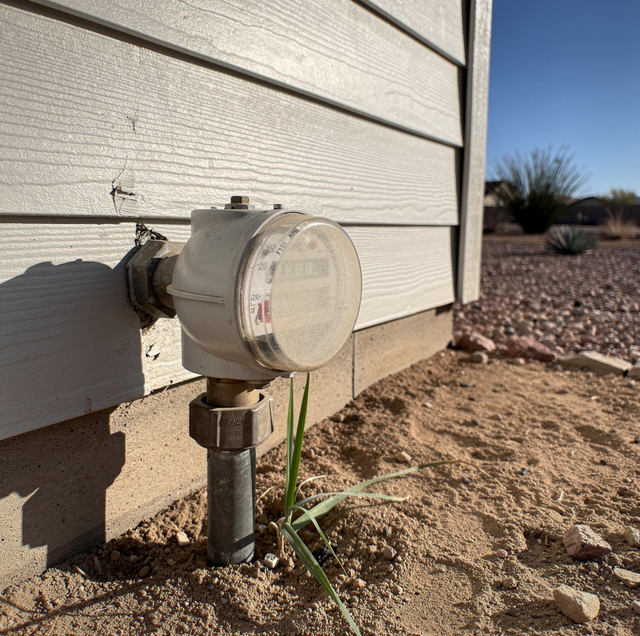
The water meter itself is a better test than the bill, because it removes the guesswork. Turn off every fixture and appliance that uses water, including ice makers and irrigation timers, and check the meter's leak indicator (usually a small triangular or star-shaped dial that spins whenever any water is flowing). If that dial moves with everything off, water is passing through the line somewhere in the system. Note the meter reading, wait an hour without using any water, and check it again. Movement confirms a leak exists; it doesn't confirm where. A slab leak is one of several possibilities, alongside an irrigation line or a leak elsewhere in the yard, but it belongs on the list, especially if the other signs below are also present.
A Warm Spot on the Floor Usually Means a Hot Water Line
If the leaking pipe is on the hot water side of the system, the escaping water carries heat with it. That heat transfers through the concrete and shows up as a patch of flooring that stays noticeably warmer than the rest of the room, sometimes obvious underfoot on tile, sometimes only detectable by hand.
This sign is specific to hot water line leaks. A cold water line leak underneath the same slab produces no temperature difference at all, which is one reason a warm spot narrows things down without ruling a leak out when the floor feels normal. If you do find a warm patch, note roughly where it sits relative to the water heater and any known fixture lines, since that location often matters once a technician starts tracing the leak.
The Sound of Running Water When Nothing Is On
Water moving under pressure through a crack in a pipe makes noise, and in a quiet house, that noise can travel through the slab and become audible as a faint hiss, trickle, or rushing sound coming from the floor or a nearby wall. It's easiest to notice late at night or early in the morning, when the house is otherwise silent and no fixture is running.
This sign gets dismissed more than any other, because a faint sound with no visible source is easy to write off as a furnace, a neighbor's plumbing, or nothing at all. Walk the house with everything off and listen near interior walls and low points in the floor plan. A sound that's consistently located in one area, rather than general background noise, is worth treating as a real signal rather than an assumption.
Cracks in Flooring or Baseboards Point to Movement Underneath
Water that saturates the soil beneath a foundation changes how that soil behaves. Clay-heavy soil expands when it's wet, and contracts as it dries, and a slab leak can keep one section of the ground wetter than the rest, causing uneven settling directly under the affected area. That uneven movement shows up above ground as new cracks in tile or flooring, gaps opening at baseboards, or a section of floor that feels slightly uneven when you walk across it.
This is a later-stage sign rather than an early one. Small hairline cracks in grout or flooring happen for plenty of reasons unrelated to plumbing, but a new crack that keeps growing, especially paired with a warm spot, a meter that moves with everything off, or a sound underneath the floor, is a different situation. At that point, the leak has likely been running long enough to affect the structure above it, and it's worth having someone confirm the cause before doing any cosmetic repairs to the crack itself.
Mold or Mildew Smell With No Obvious Source
A musty smell that shows up in a room with no visible water damage, no recent spill, and no history of a leak is one of the more overlooked signs of a slab leak, mostly because people search for a source in the wrong places, checking under sinks and around windows instead of the floor itself.
Moisture trapped under carpet, laminate, or even tile grout lines creates the kind of dark, damp environment mold and mildew need to establish, and a slab leak supplies exactly that, continuously, from underneath. If the smell is strongest near the floor rather than near a wall or ceiling, and there's no plausible outside source like a recent spill or a leaking exterior window, treat the floor itself as a suspect rather than something to mask with cleaning.
Why Professional Leak Detection Equipment Confirms What Guesswork Can't
Every sign above narrows the possibilities, but none of them tells you exactly where a slab leak is, and digging up a slab based on a guess is expensive and disruptive if the guess is wrong. This is the part of the process where equipment does what a homeowner's senses can't.
Acoustic leak detection uses sensitive listening equipment to pick up the specific sound water makes as it escapes from a pressurized line, then compares the sound's intensity at different points along the suspected path to triangulate where the leak actually is. It works because a pressurized leak produces a distinct frequency that's louder the closer the sensor gets to the source, even through several inches of concrete.
Thermal imaging works differently and is especially useful for hot water line leaks: an infrared camera reads surface temperature differences across the floor, and a hot water leak under the slab shows up as a warm outline on the thermal image, often more precisely than what's detectable by hand. Combined with a video-scoping camera run through the line itself where access allows, these tools let a technician confirm both that a leak exists and roughly where along the pipe it sits, before anyone breaks concrete. That precision is the difference between an isolated repair at one confirmed point and tearing out flooring across an entire room on a guess.
What to Do if You Suspect a Slab Leak
If you're seeing one or two of these signs, start with the meter test, since it's the fastest way to confirm that water is escaping somewhere in the system. If the meter moves with everything off, or if you've got a combination of a warm spot, a sound beneath the floor, or a new crack alongside rising bills, it's time to get equipment in to address the problem rather than waiting to see if it gets worse.
Slab leaks don't resolve on their own, and the soil movement and mold risk described above only worsen the longer a leak goes unchecked. A confirmed leak location, found with acoustic and thermal equipment rather than a shovel, is what turns an open-ended problem into a specific, targeted repair.
Frequently Asked Questions
It depends on the size of the crack and the water pressure behind it, but even a small leak can keep saturating the same section of soil day after day, and that constant moisture eventually leads to cracked flooring or a mold problem. A leak that starts as a rising water bill can progress to visible flooring damage within a matter of months, especially with a hot water line, where the heat itself accelerates surface signs.
Both materials can develop a slab leak, though the mechanism differs. Copper pipe under a slab is vulnerable to pinhole corrosion from soil chemistry and mineral-heavy water, while PEX is more resistant to that specific failure but can still be damaged by soil movement, a sharp bend installed too tightly, or physical stress where the line was never properly bedded during installation.
Not usually; most confirmed slab leaks are confined to a small section of a single line rather than a foundation-wide problem. The risk grows the longer a leak goes undetected, since sustained soil saturation in one area eventually causes localized settling. But catching a leak early through the meter test or a warm spot on the floor generally means the repair stays contained to that one section.
A perfectly still meter with no movement at all is the expected baseline when every fixture, appliance, and irrigation line is truly off. Some homes have a very slow leak indicator that ticks occasionally due to a running toilet flapper or an ice maker line cycling, so it's worth ruling those out individually before assuming any meter movement points to a hidden leak under the slab.
It can, though pressure loss from a slab leak is usually gradual rather than sudden, since the leak itself tends to start small and widen slowly over time. A sharp, sudden pressure drop across the whole house is more often tied to another cause, but a slow decline paired with a rising bill or a warm spot on the floor is consistent with water being lost somewhere underground before it ever reaches a fixture.
Moisture trapped under flooring materials creates a closed, damp environment well before enough water accumulates to cause a visible stain or crack, and mold and mildew can establish in that environment within days of sustained dampness. That's why a persistent musty smell with no obvious external source often precedes any visible sign of damage by weeks, making it one of the earliest available clues rather than a late-stage symptom.
Schedule a slab leak inspection — get the leak located with acoustic and thermal equipment before it turns into a flooring or foundation repair. Norfleet Family Plumbing serves Mesa and the East Valley. Call (480) 681-1764.
