
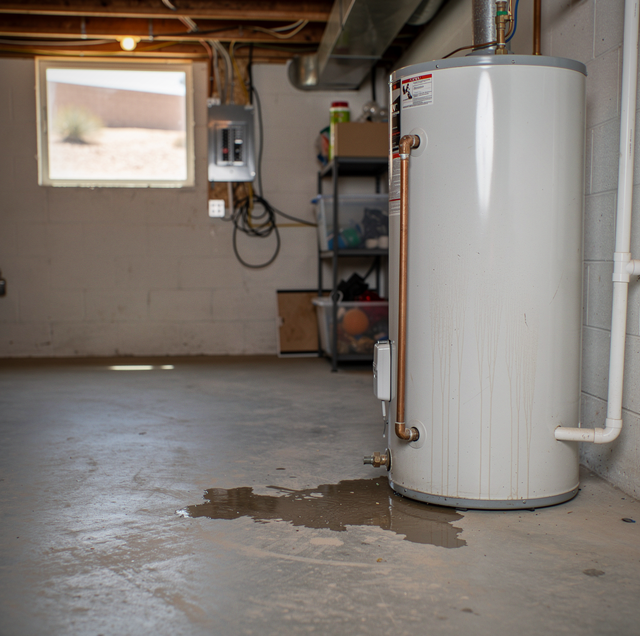
A water heater problem always seems to surface at the worst possible time, and that pressure to decide fast can make repair and replacement feel like a coin flip. A few consistent signals cut through that pressure and point toward the right call.
Why This Call Isn't Always Obvious
A water heater rarely fails all at once. It fails a little, gets fixed, then fails again somewhere else a few months later. Each individual repair seems reasonable on its own, which is exactly what makes the bigger question so hard to answer: is this unit on its way out, or did it just have a rough patch?
There's no single rule that covers every situation, but there is a set of factors that, taken together, point you toward the right call almost every time. Age, repair history, efficiency, and how the unit was installed all carry different weights, and none of them should be judged in isolation. A five-year-old heater with a failed thermocouple is a different animal than a thirteen-year-old tank with a rusty drain valve, even though both might look like "it just needs a part."
This guide walks through those factors one at a time, then puts them side by side so you can see where your situation lands.
When Age Starts to Matter
Tank-style water heaters are built with a steel tank lined with glass (technically, vitreous enamel) to prevent the steel from corroding when it comes into contact with water. That lining is never perfect. Tiny gaps and pinholes form over time, especially where the tank was welded or where fittings were threaded in. A sacrificial anode rod, usually magnesium or aluminum, is installed specifically to corrode in place of that steel, giving the tank a much longer working life than it would otherwise have.
The problem is that the anode rod gets consumed. Once it's used up, the steel tank itself becomes the next thing corrosion attacks. That's typically when a tank starts to leak from the inside out rather than from a loose fitting you can tighten. A tank in the first half of its working life almost always deserves a repair. A tank past that point is corroding in a place no wrench can reach, and an outside repair won't undo the internal damage.
Tankless units age differently because there's no tank to corrode through. Their components (heat exchanger, flow sensor, igniter, gas valve) wear individually and can often be replaced one at a time, which is why a well-maintained tankless unit tends to have a longer useful life than a tank. That longevity depends heavily on regular descaling, which matters more in areas with mineral-hard water than elsewhere.
What the Repair History Is Telling You
One repair is a data point. Two repairs on the same unit within a short window are a pattern. The distinction that matters most is whether the repairs are unrelated (a thermostat here, a valve there) or are all symptoms of the same underlying wear, such as sediment buildup causing repeated element failures or an aging tank causing repeated leaks at different fittings.
A heating element or thermostat swap on a tank unit is usually a contained, one-time fix. Replacing a gas control valve or igniter on a tankless unit is similar. But if you notice the technician keeps coming back to touch the same general area of the unit, that's usually less about bad luck and more about the whole system reaching the end of its comfortable service window.
Frequency matters more than the complexity of any individual repair. A unit that needs attention once every few years is behaving normally. A unit that needs attention every few months, even for small things, is signaling that something at the core of the system is degrading, not just one part.
The Efficiency Cost of Staying With an Old Unit
Sediment is the quiet efficiency killer in tank units. As mineral content in the water settles at the bottom of the tank, it forms a layer that acts as insulation between the burner or lower heating element and the water itself. The unit has to run longer to reach the same temperature, and in gas units, that sediment layer can also cause a rumbling or popping sound as water gets trapped underneath it and boils. Heavier sediment buildup is common in homes with hard water, since more dissolved minerals mean more material is available to settle out.
On tankless units, scale forms directly on the heat exchanger's internal surfaces rather than settling at the bottom, since there's no standing tank of water. That scale insulates the exchanger from the water flowing past it, forcing the unit to work harder to hit the target temperature and gradually reducing flow rate. This is why manufacturers specify a descaling interval, and why that interval should be shorter in hard-water areas than the default number printed in the manual.
Either way, the practical result is the same: an older, scaled-up unit costs more to run for the same amount of hot water, even before anything actually breaks. That's a real factor in the repair-or-replace decision, separate from whether the unit is currently broken.
Choosing Between Tank and Tankless If You Replace
If you've concluded that replacement makes more sense than another repair, the next question is whether to replace like-for-like or switch styles. A few mechanical differences are worth understanding before you decide.
Tank units store a fixed volume of hot water and keep it heated continuously, so recovery time (how fast the tank reheats after use) depends on the burner or element size relative to the tank volume. They're simpler mechanically, which generally means fewer components that can fail and simpler repairs when something does.
Tankless units heat water on demand as it flows through, which means there's no standby heat loss from a stored tank and no limit on how long hot water lasts, only a limit on flow rate at any given moment. They take up less floor space and typically last longer when maintained, but they have more electronic components (flow sensors, ignition modules, circuit boards) that can fail, and repairs on those components sometimes need a technician familiar with that specific brand's diagnostics.
Hybrid heat-pump water heaters are a third option worth knowing about: they use a tank but move heat from surrounding air into the water rather than generating heat directly, which makes them more efficient in warm ambient spaces but less effective in cold basements or utility closets. Whichever direction you go, the choice interacts with how the unit was installed in the first place, which is the next factor.
How the Original Installation Factors In
An aging unit that was installed correctly, with properly sized gas lines, adequate combustion air, and code-compliant venting, is a much better repair candidate than one that's been fighting its installation from day one. If a unit has struggled with inconsistent performance and the installation itself has never been evaluated, part of what looks like "the unit is wearing out" might actually be an installation issue that a repair won't fix, no matter how many parts get replaced.
This matters more with tankless units, which are more sensitive to gas line sizing and venting than tank units are. A tankless unit that's undersized for the home's simultaneous hot-water demand, or that's on a gas line sized for the old tank unit it replaced, can show symptoms that look like equipment failure (temperature fluctuation, error codes, reduced flow) when the actual issue is upstream of the unit itself. Before committing to either a repair or a full replacement, it's worth confirming the installation matches current specifications for the equipment in place.
Repair vs. Replace: Comparison Table
| Factor | Favors Repair | Favors Replacement |
|---|---|---|
| Unit age | In the first half of typical service life | Past the midpoint of typical service life |
| Repair pattern | One isolated repair, unrelated to prior issues | Repeated repairs, especially in the same area |
| Tank condition | No visible rust, moisture, or corrosion at fittings | Rust at the tank seams or active moisture at the base |
| Efficiency | Recovers heat and holds temperature normally | Noticeably slower recovery or rising utility use |
| Anode rod (tank units) | Anode rod intact or recently replaced | Anode rod fully consumed, tank now unprotected |
| Component type | Simple part: thermostat, element, valve | Core structural issue: tank shell, heat exchanger |
| Installation | Correctly sized and vented from the start | Undersized lines or venting issues never corrected |
| Noise | Occasional, minor operational sound | Persistent rumbling, popping, or ticking |
| Tankless scale history | Descaled on the manufacturer's recommended interval | Rarely or never descaled |
| Water quality in the home | Minimal mineral content, low scale exposure | Consistently mineral-heavy water accelerating wear |
The Anode Rod: A Clue Most Homeowners Miss
Of everything on that table, the anode rod is probably the single best predictor for tank units, and it's the one homeowners are least likely to know about. Because it's designed to sacrifice itself to corrosion so the tank doesn't have to, checking it directly tells you how much protective life remains, rather than guessing from external symptoms. A rod that's mostly gone or coated in calcium deposits means the tank has effectively been unprotected for a while, even if it hasn't started leaking yet. Replacing the rod on a younger unit can meaningfully extend its life; finding a heavily consumed rod on an older unit is usually the clearest signal that a repair is treating a symptom, not the actual problem.
Bringing the Factors Together
None of these factors work in isolation, which is the whole point of weighing them together rather than reacting to whatever just broke. A young unit with one contained repair and a healthy anode rod is worth fixing without much hesitation. An older unit with a repair pattern, reduced efficiency, and a spent anode rod is telling you the same thing three different ways. Somewhere between those two extremes, the honest answer is that the specifics of your unit, its installation, and its maintenance history matter more than any general rule of thumb, which is exactly why a hands-on inspection beats guessing from symptoms alone.
Frequently Asked Questions
Flushing removes loose sediment sitting at the bottom, but it won't repair a tank lining that's already been compromised or restore a section of steel that's begun corroding. Flushing is a maintenance step that prevents future sediment buildup; it isn't a repair for existing internal damage.
A fitting leak usually shows up as a drip or damp spot directly beneath one connection point, like the drain valve, a water line union, or the temperature and pressure relief valve, and it often eases up when that specific connection is gently snugged. A tank-shell leak tends to look different: water pools underneath the entire tank rather than under one spot, or a seam partway up the side stays damp with no loose fitting nearby to explain it. If that's what you're seeing, shut off the water supply and the power or gas to the unit, set down towels or a shallow pan to catch what's already in the lines, and avoid tightening anything on the tank body itself, since there's no fitting there to adjust.
It can, mostly because of combustion air and venting rather than the water itself. A garage installation typically has more available combustion air and a shorter, simpler vent run to an exterior wall, but garages also swing much colder in winter, which means more energy goes into raising incoming water to temperature. An indoor closet maintains a steadier ambient temperature, which helps shorten recovery time, but it's a tighter space that depends on a properly sized combustion air supply and a vent routed to code, since there's less room for error. Neither location is automatically better; it comes down to whether the specific vent path and air supply were sized correctly for where the unit actually sits.
Yes. Units installed in an unconditioned garage or attic experience wider temperature swings than ones in a conditioned utility closet, and that swing puts more thermal stress on tank welds and fittings over the years. It's not usually the deciding factor on its own, but it's part of why two units of the same age and brand can wear differently.
That smell can come from sulfate-reducing bacteria reacting with a magnesium anode rod inside the tank, particularly in water with certain mineral profiles. It's a water-chemistry issue inside the tank, not necessarily a gas leak, though any gas odor should always be treated as a safety issue and checked immediately regardless of the cause.
The tank itself corrodes the same way regardless of fuel type, but electric units have simpler heating components (elements and thermostats) with fewer parts exposed to combustion byproducts, which is why electric heating components sometimes outlast the burner assembly and venting parts on a comparable gas unit, even when the tanks themselves are rated for a similar lifespan.
None of this has to be sorted out alone or from guesswork. The most reliable path forward is usually a hands-on inspection that checks the anode rod, the tank or heat exchanger condition, and the installation as a whole, rather than reacting to whichever symptom happens to show up first. An honest read of where a unit currently stands beats reacting to a single repair or a single strange noise in isolation.
Get a water heater inspection — get a straight answer on repair versus replacement before you spend another dollar guessing. Norfleet Family Plumbing serves Mesa and the East Valley. Call (480) 681-1764.
