
How Long a Water Softener Lasts and What Fails First
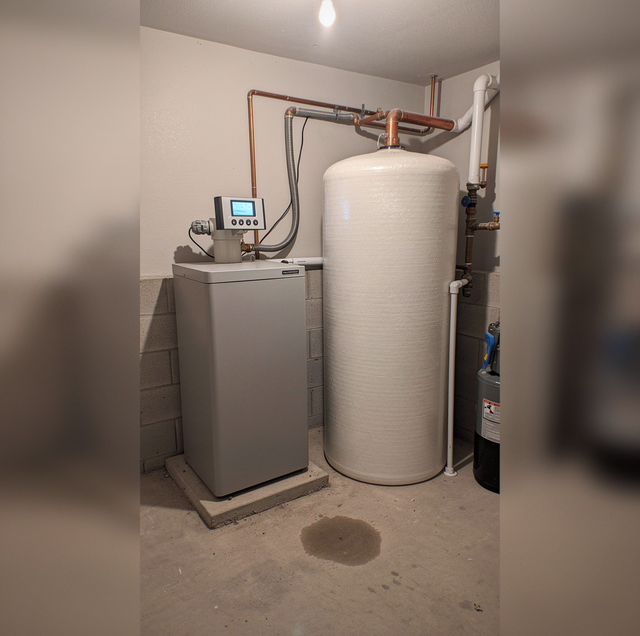
Ask a plumber how long a water softener lasts and the answer arrives as a span of years rather than a single number, commonly ten to fifteen years, with well-kept units running past that. The spread has a cause. A softener's life is measured in work rather than calendar time, and how much work a unit has already done depends on the hardness and iron content of the water feeding it, whether that supply carries chlorine, and how it was sized on the day it went in. A correctly sized softener on clean municipal water can still be working at the top of that span, while the same model, undersized for a busy household on iron-bearing water, is finished well before reaching the bottom of that span.
The other reason for the range is that a softener does not quit all at once. Inside the cabinet are parts that age on separate clocks: a bed of resin sitting in a pressure tank, a motorized control valve bolted to the top of it, and a brine tank feeding that valve. Knowing which of the three is failing is what separates a unit that needs a part from a unit that has aged out. The ten to fifteen-year figure applies to the resin bed and the tank holding it; the control valve on top has a shorter service life of its own, so a unit reaching the top of that span usually does so on a rebuilt head.
Quick Answer: Most residential water softeners last 10 to 15 years, and well-kept units last longer. Hardness, iron, chlorine, and the size chosen at installation determine where a unit lands, and the control valve usually fails before the tank does.
The Resin Bed and Where Capacity Goes
Thousands of small polymer beads carry the exchange sites that pull calcium and magnesium out of the water and release sodium in their place. Once those sites fill, the control valve draws saturated brine from the salt tank and floods the bed, stripping the hardness minerals back off and flushing them away. A softener trades hardness for sodium and does no cleanup of taste, odor, or sediment, so those complaints about softened water point to the supply rather than to the resin.
Attrition: Every cycle swells the beads as they load and shrinks them again as brine strips them. Over enough cycles, beads fracture, the fragments wash out during backwash, and the bed loses volume. The unit simply treats fewer gallons before it runs low, and hardness starts to show up at the end of a heavy day.
Fouling: Dissolved iron in the supply oxidizes upon reaching the bed, coating the beads with a film that brine alone cannot lift. A fouled bed retains a fraction of its former hardness, and the loss occurs faster than ordinary aging would explain.
Oxidation: On a chlorinated municipal supply, free chlorine attacks the crosslinks that give each bead its structure. Beads soften, lose shape, and pack down instead of staying loose. A packed or broken-down bed also invites channeling, in which incoming water carves preferred paths through the resin rather than spreading across it. Contact time drops, part of the flow passes through barely treated, and the unit reads as running normally while water quality slides.
The Control Valve and Its Head
The valve on top of the resin tank does the thinking and the switching. It tracks water use or elapsed days, then steps the unit through backwash, brine draw, slow rinse, fast rinse, and refill before returning it to service. Inside the head, a piston travels through a stack of seals and spacers, driven by a small motor and cam, with a board reading position along the way.
Seals harden with age. Grit scores them. Chlorine works on those elastomers the same way it works on resin. Once a seal set is worn, water crosses between chambers it should never reach, and the failures look dramatic: the unit runs to drain continuously, sticks partway through a cycle, stops drawing brine, or delivers hard water while the display steps along as though nothing is wrong.
This assembly is the single most common failure point on a residential softener, which is why a ten-year-old unit is so often a rebuild rather than a replacement. Seal kits, spacers, and pistons are standard service parts for the common valve lines, and a plumber can bring a worn head back to spec without touching the tank or resin. That work is not a homeowner job, since the head sits under line pressure and comes apart in an order that matters.
Before calling for service, find the brand and valve model stamped on the control head or its label. Whether parts are still made for that valve line often decides if an older unit gets rebuilt or replaced.
The Brine Tank and Its Assembly
The brine tank's job is to hold salt and produce fully saturated brine for the next regeneration. When it stops, the resin never recharges, and the symptom looks exactly like a dead resin bed.
Bridging is the common version. Humidity and fine salt form a hard crust that spans the tank and rests on the walls, with an air gap and water underneath. From the top, the tank looks full. Below the crust, water never comes into contact with salt, and the unit regenerates with something close to plain water. The tell is salt that hasn't dropped in weeks, while hard water symptoms come back.
Mushing is the other. Recrystallized salt settles into sludge at the bottom, blocking flow through the well and the brine line. Both call for someone who can clear the tank without wrecking the float assembly or the well.
The float assembly measures how much water goes in for the next batch of brine, and the safety float above it is the shutoff that prevents overflow when the fill does not stop on its own. A grid plate, in tanks built with one, holds salt above the water line so brine forms in the space below and sediment settles clear of the salt.
If the brine tank holds standing water above the salt, stop adding salt and call a plumber; a fill valve stuck open can flood finished flooring once the safety float gives up. Never pry at a salt crust with a tool.
For a homeowner, the checks stop at the salt level and what the display is showing. Everything past that belongs to someone working from the unit's service manual.
The Sizing Decision Made on Day One
Softeners are sized based on a daily grain load, which is the hardness of the incoming water multiplied by the gallons a household uses in a day. Come in short, and the unit reaches the end of its capacity sooner, which means more regenerations per month, every month, for the life of the unit.
That is how two identical softeners installed the same week end up in very different condition a decade later. Every regeneration is a wear event: beads swell and contract, the piston makes another full trip through the seal stack, the motor and cam turn again, and more salt moves through the brine side. A unit running twice as many cycles wears out on a much shorter arc than its age suggests, and it also runs out of soft water late in the day, when demand is highest.
Households move the target as well. A second full bath, two more people, or a supply with enough iron to eat into capacity all raise the load on a unit sized for the house as it was. Cycle count is what the machine actually keeps score of, and sizing sets that count in motion on day one.
Which Failures Are Worth a Part
Repairs worth making are those in which a single component has worn out and the rest of the machine is intact. A worn seal and spacer set, a dragging piston, a failed motor or control board, a broken safety float, a leaking brine line fitting: these are parts, and on a unit still sized correctly for the house they buy years rather than months.
The picture changes once the pressure tank itself is involved. A bed fouled hard with iron or broken down by years of chlorine will not come back with more salt or a longer brine draw. A cracked distributor tube or a failed lower screen can let resin escape into the household plumbing, turning a softener problem into a fixture problem. A tank weeping at the threads is finished. And a valve line out of production long enough that seal kits have dried up puts a hard ceiling on any repair.
One failed part on a correctly sized unit inside its expected years is a repair. Two systems failing together on a unit past the top of that range, or any failure with no parts behind it, is a replacement.
When a Softener Has Reached the End
Start with age against that ten to fifteen year span. A unit under ten years old that has quit almost always has a part behind it. A unit well past fifteen that has quit rarely has one worth chasing. The interesting cases sit in the middle, and the shape of the symptom sorts them out.
Sudden, complete loss of soft water points to the valve or the brine side. Something stopped moving, stopped sealing, or stopped drawing. Hardness that creeps back gradually over months, showing first at the end of heavy-use days and later all the time, points at the bed and capacity falling off as beads break down or foul.
Salt behavior is the second reading. Salt that stops disappearing while hardness returns means brine is not being made or not being drawn. Salt disappearing faster than it used to means the unit is cycling more often than it should, which is either due to a growing load or a control that has lost its settings.
Check the display for whether it is advancing or dark. Check the salt level and whether it has moved since last month. Those two observations, plus age and symptom pattern, are enough to walk into a service call informed. A plumber closes the loop by testing hardness at a treated fixture, watching the valve cycle under pressure, sampling the bed if the tank has to be opened, and checking whether parts are still available for that head. A fifteen-year-old softener with a worn valve and a sound tank is still a rebuild. The same unit with an iron-crusted bed and a sticking piston has aged out.
Frequently Asked Questions
Most control boards maintain the time of day during short outages via a capacitor or a small backup battery, and the unit picks up where it left off. When that backup is dead, the clock resets and regeneration drifts to whatever hour the power returned, which can drop a cycle into the middle of the afternoon. The house gets untreated water during a cycle, so hard water arriving at a predictable hour is often a clock problem rather than a mechanical one.
It affects the brine tank more than the resin. Rock salt carries insoluble mineral content that never dissolves and settles as grit in the brine well. Evaporated pellets are the cleanest of the common choices. Potassium chloride suits households limiting sodium, though it dissolves differently and the control usually needs its salt setting adjusted for it.
Yes, and it shortens useful life rather than extending it. An oversized unit regenerates seldom, and a bed sitting idle for long stretches gives settled matter and biological film a chance to establish in the resin. Most controls carry a forced regeneration setting that runs a cycle after a set number of days, and it belongs switched on.
Once a year is the usual interval. The check worth having is the injector and its screen, which foul with fine sediment and are a frequent cause of weak or absent brine draw.
On most installations, they do not: exterior spigots and irrigation lines are typically tied in ahead of the softener, so outdoor water never counts against its capacity. If yours were plumbed downstream, the unit has been treating water headed for lawn and beds, which adds regenerations no sizing calculation accounted for and explains a softener that gave out years early.
No. Softener warranties are usually tiered, with the longest term on the resin and salt tanks, a shorter one on the control valve, and the shortest on the electronics. The number quoted in the advertising is almost always the tank term, so it says little about the coverage carried by the parts a service call actually involves. Many warranties also end with the original owner and do not follow the house.
Find out whether your softener needs a valve rebuild or a full replacement — a technician can test the treated water, inspect the control head, and check parts availability for your model. Norfleet Family Plumbing serves Mesa and the East Valley. Call (480) 681-1764.
