
Sewer Line Inspection Before Buying a Home: When to Book It
The inspector has finished the walk-through, and you are standing in the kitchen of the house your offer was accepted on. Upstairs, your tub drains in a steady swirl, your toilets flush clean, and the island sink empties while your agent flips through the inspection notes. Everything you watched drain away in that hour left through one buried pipe, and nobody looked at it.
That pipe is your sewer line, running under your front yard to the public sewer where no walk-through can follow. Whether you put a camera in it, and when you book that camera, depends on the house you are buying and on how far along your purchase is. Get the timing right, and you see the pipe while it still matters.
What a Standard Home Inspection Stops Short Of
A general home inspection covers what is visible and accessible, and a sewer line is neither. The home-inspection profession's Standard of Practice, and the revision approved in January 2026, which is marked as not yet in effect, lists the plumbing an inspector must look at: the interior water service and distribution, and the predominant interior drain, waste, and vent systems, including fixtures.
The word that carries the weight for a buyer is "interior". The same document lists underground items among those an inspector is not required to inspect, naming wells, cisterns, and underground storage tanks, and separately excuses the inspector from judging whether a house has enough cleanouts for effective drain cleaning.
Your sewer line runs below grade and remains underground until it reaches the public main, so it lies beyond the edge of that interior scope. An inspector who runs every fixture is testing whether water leaves the house, a different question from what shape the pipe is in once it is under the yard. Ask whether your inspector scopes sewer lines or refers that work to a plumber before you assume the line is covered.
What Hides Below a Yard That Drains Fine on Inspection Day?
A clean drain test proves less than it appears to. Running a tub and flushing toilets send a few minutes' worth of water through a line that, once you move in, carries a whole household's daily load, and a pipe can pass that short test even as it is already partway to failing.
The camera sees what flow cannot. A length that has sagged holds standing water where the pipe should be dry, a joint that has shifted leaves a lip that snags paper, and roots that found a gap start as fine strands long before they grow into a mass that stops water. A house that has sat empty for months gives none of that a chance to show up as a slow drain.
For a buyer, the footage also carries a history the listing does not. A stretch of newer plastic spliced into older pipe means someone has already dug there, and the repair coupling marks exactly where. A line that changes material partway to the street shows where an earlier job stopped. Neither is a defect on its own, but both mean the line has needed attention before, and you want to know whether the rest of it is the same age as the part that failed.
A camera that cannot get past a point is a finding too. Where the head stops, and why, belongs in what you take away from the visit.
Houses That Move the Sewer Scope Up Your List
The age of the house matters more than how it looks upstairs. A remodeled kitchen and new fixtures can be connected to the same sewer line the house was built with, because the pipe under the yard is usually left alone until it causes trouble. An older home whose buried drain piping has never been replaced is the clearest case for a scope.
Mature trees between the house and the street raise the priority, since roots grow toward moisture and a sewer joint is a steady source of it. So does anything built over the line's path: a driveway, a patio slab, a pool deck, or a room addition on the side facing the street. A problem found under open yard is a dig; the same problem under concrete means removing and replacing the concrete too.
Look at the yard on your second visit. A strip of newer sod or a patch of fresher concrete running in a line from the foundation toward the street often marks an earlier excavation. A cleanout cap that is cracked, missing, or loose is worth pointing out to the technician, as is any outdoor sewage odor near that cap.
Inside, a gurgle from a tub when a toilet flushes, or a slow floor drain while every sink runs fine, can point to the shared line rather than the individual fixtures. A house sold vacant, as part of an estate or after a long listing, deserves extra weight because nobody has been living in it to notice any changes.
A newer house with none of those markers is where skipping the scope is a reasonable call. Any one of them on an older property is reason to book it.
Getting a Camera Into a House You Do Not Own Yet
Before closing, access runs through the agents, and your agent arranges a time with the listing side, just as the general inspection was scheduled. The inspection runs the main sewer line from the house to the city connection, going in through an outside cleanout, the capped fitting where the line can be reached from the yard.
Confirm with your agent before the visit that the water is on. A vacant house with the supply shut off cannot have fixtures run, and running water through the house during the scope lets the technician watch where it moves and where it sits. If the seller still lives there, a quiet hour with no laundry or dishwasher running keeps the picture on the monitor clear.
Never unscrew the cleanout cap yourself; leave it for the plumbing technician running the camera to open and reseal, because a line blocked farther down can hold sewage and sewer gas under pressure behind that cap.
What Hides in Footage You Only Hear Described?
A verbal summary of a scope is a starting point, and the video is the evidence. A few requests made up front make the footage worth having.
Ask for the camera to travel the full length, from the cleanout to the connection with the city sewer, rather than stopping at the first problem it meets. A defect near the foundation and a second one out by the street are two different conversations, and a run cut short leaves you knowing about only one of them.
The inspection camera has recording capability, so ask before the visit whether you can keep a copy of the footage rather than relying on your memory of the screen. Ask that each finding be tied to its distance from the cleanout, and that the pipe material be named along the run, with any change in material noted where it occurs.
Where the camera finds something, ask for a clear still of that spot, with its distance noted, rather than a description alone. A second plumber you bring in later can then look at the same joint you saw, and you are comparing opinions on one picture.
Where the Camera Belongs in Your Buying Timeline
Before an offer, a scope is harder to arrange, since the seller has to agree to the access before you have any deal in place. It earns that effort mainly on a house where the warning signs above are already obvious on a showing.
The strongest slot is early in the inspection period, booked the same week as the home inspection or the day its results come in. Purchase agreements often set an inspection period, and your agent or attorney can explain how yours works. Booking early leaves time for whatever the camera turns up to lead somewhere: a plumber's opinion on the footage, a repair estimate, a conversation with your agent.
If the home inspection notes mention a slow main drain, a sewage odor outdoors, or a damaged cleanout cap, book the camera inspection the same day, since each points to the line the general inspection could not see.
A scope squeezed in near the final walk-through leaves the least time for any of that. After closing, a scope still provides a baseline for your new home's sewer line, but it is no longer part of the purchase.
So the camera belongs in the first days after your offer is accepted, beside the home inspection, while what it finds can still shape the rest of the purchase.
Frequently Asked Questions
Often, but it changes the job. Without an exterior cleanout, the technician has to find another way into the line, and some houses need a new cleanout added before the camera can run the full length. Ask your agent to find out from the listing side whether one exists before you book.
It matters less, but the line under a new house is not automatically sound. Construction debris can be left in new pipe, and trench backfill that was never compacted can sink over the first years and pull a joint out of line. On a home a few years old, your scope can catch that before you have lived with it.
Watch it before you rely on it. Check the date against any repair since, confirm the cleanout you see matches this house, and check whether the run itself reached the city connection. If any of those is missing, your own scope fills the gap.
The sewer camera fits lines as small as 2 inches across, so branch drains under a slab can be scoped separately if something you noticed inside points to them. That is a separate question from the main sewer line, so name the pipes you want looked at when you call to book.
Yes. A trap is the U-shaped bend under each fixture that holds a plug of water against sewer gas, and months unused let it evaporate. The result is sewer odor indoors that can make a sound line seem suspect, so ask your inspector to run every fixture before you judge the smell.
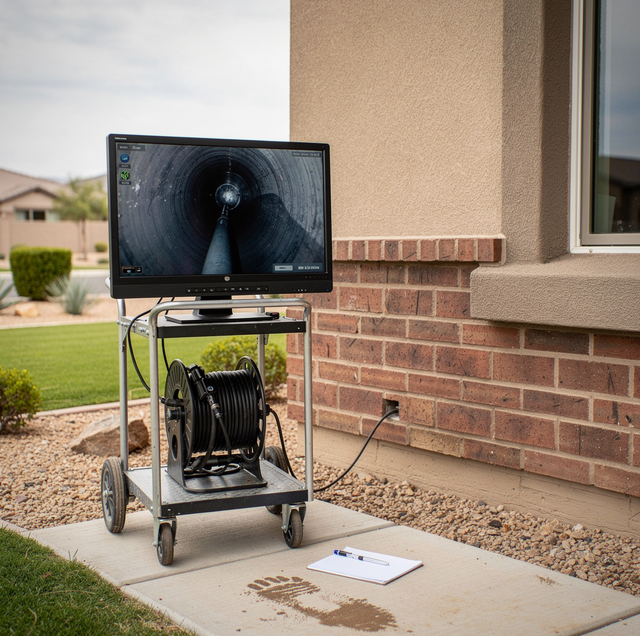
It is, if your schedule allows. A sewer camera lets you watch the inside of the pipe in real time on the monitor while the technician runs it, a very different experience from reading about it later. You can ask for a pause at a joint, a zoom on something odd, or a second pass. Standing beside the monitor, you also learn where the line runs and where the cleanout sits, which matters once the house is yours and you need to point the next plumber to it.
Book a sewer camera inspection early in your inspection period — a technician runs the camera from the house to the city line through an outside cleanout, and you can watch the footage live. Norfleet Family Plumbing serves Mesa and the East Valley. Call (480) 681-1764.
