
Sudden Low Water Pressure Throughout the House: 6 Real Causes
You turn on the kitchen faucet and get a thin stream instead of a full one, then check the shower down the hall and get the same weak flow. A single fixture acting up is usually a local clog. Every fixture losing pressure at the same time is a different kind of problem, one that lives upstream of every fixture at once, and figuring out which upstream point is failing is most of the battle.
Why a Sudden, Whole-House Drop Points Upstream
Plumbing works like a tree: one trunk line feeds a series of branches, and each branch feeds individual fixtures. A weak faucet in one bathroom usually means something is wrong with that one branch, most often a clogged aerator or a partially closed valve under that sink. When the trunk itself is restricted or damaged, though, every branch downstream feels it at once, whether that's a kitchen faucet, a shower head, or the washing machine.
Confirm that before chasing any specific cause. Run two or three fixtures on opposite ends of the house, one at a time, and note whether the weak flow appears everywhere or only in one spot. Whole-house weakness narrows the list to a handful of trunk-level suspects: the main line, the pressure regulator, a hidden leak, the municipal supply, mineral buildup at multiple fixtures, or old corroded pipe. The pattern of when and how the pressure dropped usually points toward one of them.
The Main Water Line May Be Damaged
The main line runs from the water meter to the house, and it's the single busiest point of failure for a sudden, whole-house pressure change. Older service lines made of galvanized steel or even early plastic can crack, collapse, or partially corrode closed, especially where the ground has shifted under a foundation or where a line was never bedded properly when it was laid. A crack lets water escape before it ever reaches the plumbing inside the house, so every fixture downstream loses pressure at the same time, in the same proportion, no matter which one you open.
A collapsed or crushed section, common where clay soil expands and contracts with moisture changes, acts differently: it doesn't leak; it just narrows the pipe's usable diameter, so the whole house behaves like it's being fed through a coffee straw instead of a full-size pipe. Both problems show the same symptom (uniform pressure loss at every fixture) but one wastes water somewhere in the yard, and one doesn't, which is a useful clue when you're trying to tell them apart before a technician arrives.
A Failing Pressure Regulator Can Choke the Whole System
Many homes have a pressure-reducing valve (PRV) installed where the main line enters the house, stepping municipal pressure down to a safer range for household plumbing. Inside, a spring-loaded diaphragm holds a set pressure by flexing open and closed as demand changes. Mineral deposits, sediment, or a worn diaphragm can cause that mechanism to stick in a mostly-closed position, and once it does, it restricts flow to the entire house evenly, since every fixture draws from the same regulated line.
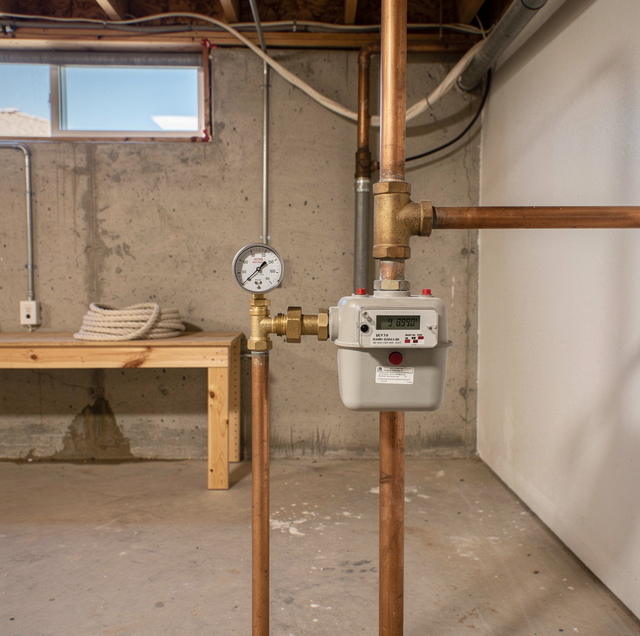
A PRV failure often announces itself gradually at first (slightly weaker showers over a few weeks) before dropping off sharply, unlike the sudden, all-at-once failure of a burst line. If your home has a PRV, it's usually a visible bell-shaped or cone-shaped fitting near the main shutoff, and a pressure gauge threaded onto a hose bib on either side of it can confirm whether it's actually regulating correctly or stuck low.
A Hidden Leak Can Quietly Steal Your Pressure
A leak between the meter and the fixtures draws water (and pressure) out of the system before it reaches any faucet, resulting in the same even, whole-house weakness as a damaged main line or a stuck regulator. Slab-on-grade homes are particularly exposed to this kind of leak because supply lines often run through or under the concrete floor, where a pinhole leak in copper pipe, accelerated by mineral-heavy water or soil chemistry, can run for weeks before it's obvious.
The tell for a hidden leak is usually indirect: a warm spot on an otherwise cool floor, a section of flooring that stays damp for no clear reason, or a water meter that keeps spinning even when every fixture in the house is off. That last test is worth doing early, since it separates a leak from a mechanical restriction (regulator or pipe) in a way nothing else does. If the meter moves with everything shut off, water is going somewhere other than a faucet.
The Municipal Supply Itself May Be the Cause
Not every whole-house pressure drop starts inside the home. Utilities occasionally perform maintenance work, flush hydrants, or repair a break in the distribution network, and any of these can drop pressure to every house on that section of the line for hours or days. This kind of drop tends to arrive suddenly, affect neighboring homes at the same time, and resolve once the utility finishes the work, so a quick check with a neighbor is worth doing before assuming the problem sits inside your own plumbing.
A supply-side drop can also be more permanent when growth has outpaced the capacity of an older distribution main, in which case pressure stays low at certain times of day (mornings and evenings, when demand peaks) rather than returning to normal. Either version feels the same at your own fixtures, so telling a municipal issue apart from an internal one usually comes down to confirming whether pressure at the meter itself, not just at the fixtures, is actually low.
Clogged Aerators and Whole-House Mineral Buildup
A single clogged aerator only affects one fixture, but mineral-heavy water can coat the inside of nearly every aerator, showerhead, and valve in a house at roughly the same pace, which can look like a single whole-house event even though it's really dozens of small, separate restrictions happening in parallel. Calcium and other dissolved minerals crystallize wherever water slows down or sits, and screens, aerators, and cartridge valves are exactly the kind of narrow passages where that buildup collects fastest.
The way to separate this from a trunk-line cause is mechanical: remove an aerator or showerhead and run the fixture directly from the pipe. If flow improves noticeably with the screen removed, mineral buildup at the fixture level is at least part of the problem, and it's worth checking a second and third fixture the same way before ruling out a trunk-level cause entirely, since both can occur together.
Corroded Galvanized Pipe Narrows the Whole System
Homes built with galvanized steel supply piping, common before copper and PEX became standard, face a slower version of the same problem a collapsed main line causes. The zinc coating inside galvanized pipe wears away over decades, and the exposed steel underneath corrodes and builds mineral scale on the inside wall of the pipe. That buildup narrows the usable diameter year after year, the same way plaque narrows an artery, until a pipe that once carried a full flow is functionally a much smaller pipe wearing the outside of a bigger one.
Unlike a sudden line break, galvanized corrosion causes a gradual decline that's easy to miss until it crosses a threshold and starts to feel sudden, and it often shows up most at the fixtures farthest from the meter, since they're fighting the restriction of every foot of corroded pipe between them and the source. Those homes are also more likely to have galvanized fittings hidden behind walls or under a slab, part of why repiping, rather than spot repair, tends to be the long-term answer once corrosion is confirmed.
How to Narrow Down Which Cause Is Yours
A few simple checks, done in order, usually point toward the right cause before anyone touches a wrench. Start by confirming the drop is whole-house rather than one fixture, using the two-fixture test described earlier. Next, thread a pressure gauge onto an outdoor hose bib and compare the reading to a normal household range; a reading well below that range confirms the problem is upstream rather than at individual fixtures.
From there, check the water meter with everything off to rule out a leak, remove an aerator on one fixture to rule out mineral buildup at that fixture, and ask a neighbor whether their pressure changed at the same time to rule out a municipal issue. What's left after those checks (usually the main line, the regulator, or old galvanized pipe) is the kind of problem that benefits from a professional pressure test and a look at the line itself, since further guessing without opening anything rarely settles it.
When a Professional Look Makes Sense
Pressure diagnostics only go so far from the outside. A gauge test, a check of the meter, and a look at the regulator settle most of the easy questions, but confirming a main line leak, a collapsed section of pipe, or how far galvanized corrosion has progressed calls for equipment most homeowners don't have on hand: a pressure test rig, a listening device for underground leaks, or a camera that can see inside the pipe itself.
Sorting out which of these six causes matches what's happening at your fixtures takes a handful of simple checks, but confirming it, especially anything involving the main line, a hidden leak, or old pipe, calls for a hands-on look with the right gauges and tools.
Frequently Asked Questions
Municipal water systems typically deliver between 40 and 80 psi to a house, and most plumbing fixtures and appliances are designed to perform normally within that range. A hose-bib gauge reading below 40 psi is generally considered low enough to explain weak flow at every fixture, while a reading above 80 psi is its own problem (accelerated wear on valves, supply lines, and appliance connections) that a pressure-reducing valve is meant to prevent.
Yes, and it's one of the more overlooked causes. Older gate valves can fail internally so the valve stem spins freely while the actual gate inside stays partly closed, which looks and feels like a normally operating valve from the handle but restricts flow to the entire house exactly like a regulator stuck low. This usually happens at the main shutoff or at a valve just past the meter, and it's worth checking before assuming a bigger repair is needed.
If the drop only shows up on hot water and cold pressure stays normal, the water heater itself is a more likely cause than anything upstream. A failing dip tube can shed plastic fragments that clog the heater's internal outlet or downstream fixtures, and heavy sediment settled at the bottom of a tank can partially block the outlet nipple, both of which reduce hot-water flow specifically while leaving cold-water pressure untouched.
Yes. Hydrant flushing programs, which utilities run periodically to clear sediment from distribution mains, can drop pressure across an entire section of pipe network for a few hours while flushing is underway, then return to normal once it's finished. A nearby fire event drawing heavily from the same main can cause a similar, faster pressure dip that resolves once demand eases.
A PRV ships from the factory with a default setting, often around 50 psi, but nearly every residential model includes an adjustment screw on top of the valve body that adjusts the spring tension of the internal diaphragm. Turning that screw clockwise raises the outlet pressure and counterclockwise lowers it, which means a valve that seems to be failing sometimes just needs a correct adjustment rather than a full replacement.
Yes, since every gallon of water in a softened home passes through the resin tank before reaching any fixture. A fouled resin bed, a stuck bypass valve, or a clogged distributor tube inside the tank restricts that single point the same way a bad regulator does, and because the softener sits on the main line rather than a branch, the restriction shows up evenly at every fixture in the house rather than just the ones plumbed for soft water.
Schedule a whole-house pressure check — get a clear answer on what's restricting flow before it turns into a bigger repair. Norfleet Family Plumbing serves Mesa and the East Valley. Call (480) 681-1764.
