
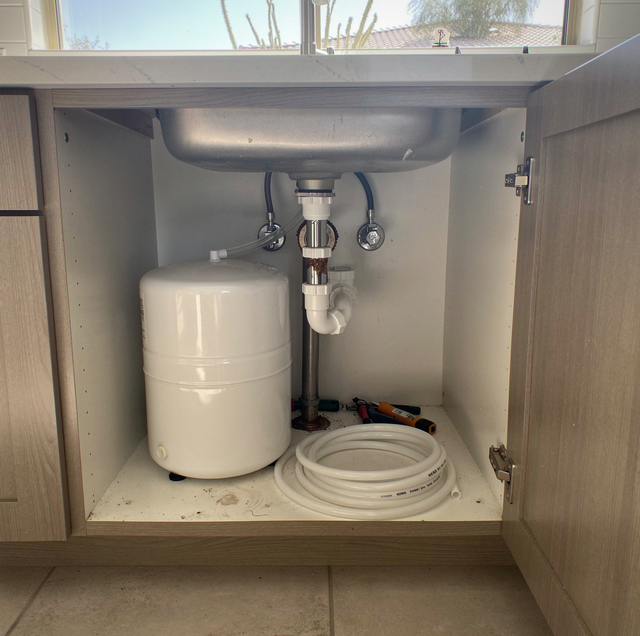
A reverse osmosis system is designed to send water to the drain: the membrane rinses away the minerals and dissolved solids it separates from the water headed for the storage tank. What is not supposed to happen is for that drain line to keep running long after the tank should be full, or to run all night with nobody touching a fixture. Each drain pattern pairs with the part it implicates:
| What You Notice at the Drain | Part It Implicates |
|---|---|
| Runs for a while after the faucet is used, then goes quiet | A normal production cycle while the storage tank refills |
| Never stops, even though the storage tank tests full | A shutoff valve that has not closed, or a check valve letting stored water flow backward through the membrane |
| Runs all night and the tank is still only partly full | Slow membrane production, or a restriction keeping tank pressure from reaching the shutoff point |
| The tank fills, then loses pressure again with the feed valve untouched | Water flowing backward out of the tank, through the membrane, and out the drain line |
| A hiss or trickle at the drain saddle with no faucet use and nothing being made | A shutoff valve stuck slightly open, or a loosened fitting at the flow restrictor |
How the Automatic Shutoff Valve Stops the Flow
The valve that ends a production cycle sits on both the feed line and the line from the membrane to the storage tank, and it responds to pressure rather than to a timer or a volume count. Inside the tank, a sealed air charge pushes back against the water filling the space beside it, so the back-pressure inside the tank climbs steadily as it fills. Once the back-pressure builds high enough relative to the incoming water, the valve closes the feed line. Production stops, and so does the flow to the drain that accompanies it. Because the valve compares tank pressure with incoming pressure, weak incoming pressure can leave the tank short of the point where the valve closes, and the drain keeps running.
The Check Valve's Job Once the Feed Closes
A second, smaller part sits on the outlet side of the membrane housing, and its only job starts the moment the shutoff valve closes. Without it, the pressurized water already stored in the tank would find the easiest path back out, which is straight through the membrane it just came from, carrying the concentrated minerals from the reject side of the housing along with it. The check valve blocks that path, holding the tank's pressure in place until the next time a faucet handle opens and calls for water. A check valve that has torn its seal or is held open by grit no longer blocks anything, and that failure can explain a tank that reads full one moment and is emptying itself back through the membrane and out the drain line the next, with the shutoff valve closed and nobody near the faucet.
Tank Pressure and the Air Charge Behind It
The storage tank holds its water behind that same sealed air charge, and a tank that has lost part of that charge can show up at the faucet as less water delivered and, on some systems, as a longer-running drain. That air charge is set before the tank goes into service and does not refill itself. A tank that has lost part of its contents stays low until air is added back through the valve built into the tank, and the charge only reads correctly when the water is drained out of the tank.
Low Incoming Pressure and a Worn Membrane
Low incoming water pressure can reduce the efficiency with which the membrane separates dissolved solids from the water passing through it, which can extend the time the drain runs before the tank reaches its shutoff point. A membrane that has aged or picked up scale and organic film on its surface can behave the same way, even when incoming pressure tests normal, requiring a longer run to fill the same tank because more of what reaches it is diverted to the reject side rather than passing through as product water. Either cause looks identical from the cabinet: a drain that keeps going well past when it should have quieted down. A membrane in that condition does not fail all at once, either: product water quality and output can both slip as a membrane ages, so a system can keep filling the tank while more of what the membrane is meant to hold back passes through.
Matching the Flow Restrictor to the Membrane
A small fitting on the drain line, the flow restrictor, is sized specifically to the membrane installed in that housing. Its job is to hold back enough pressure inside the housing for separation to occur at all, while still allowing the reject stream to reach the drain rather than backing up. A restrictor that does not match the membrane, whether from a mismatched replacement part or one left out during a repair, lets water move through the system at the wrong rate for that particular membrane, and a drain line that never quite settles into a normal cycle can be the first sign that the two parts do not agree with each other.
RO tubing holds pressure from the supply and the storage tank, and a fitting released under that pressure can spray water into the eyes of whoever is under the sink. A plumber closes both and relieves the pressure.
Diagnosing an RO Drain That Will Not Stop
A drain that will not stop can have more than one of these faults at once, so a repair that stops at the first bad part can leave a second one running. The parts to check are the shutoff valve and the check valve together, since either one failing keeps the drain open; the tank's air charge; the membrane's condition and its match with the flow restrictor; the feed pressure measured at the RO unit's own supply line rather than a fixture elsewhere in the house, since pressure can differ from one branch of the plumbing to another; and the fittings at the drain saddle and under the sink.
A running RO drain makes a steady trickle under the sink, and it can be the water-running sound heard in a quiet house at night. That sound hours after the last glass was drawn fits the drain that never stops.
If a leak turns up under the sink while any of this is being checked, the feed valve and the sink's own cold-water stop are the two valves to close, not the drain saddle or the tubing itself. No tubing gets cut or pulled loose while the system is still under pressure, and the drain saddle itself is never drilled out or repositioned as a troubleshooting step; a saddle that is placed wrong gets replaced, not moved.
Frequently Asked Questions
Yes. With the drain line pinched, kinked, or accidentally capped, nothing rinses the rejected minerals off the membrane's surface, so they build up on it and can foul it for good, where a closed feed valve only pauses production.
Yes. The saddle is meant to tie into the drain arm above the trap, not below it. A connection made on the wrong side of the trap can allow sewer gas to reach the fitting through the drain line, and a saddle clamped too tightly during installation can crack the drain pipe it is fastened to.
That hole is part of an air gap built into some RO faucets, and it is designed to do exactly that when the downstream drain path is even partially restricted. Rather than letting pressure build silently, the air gap forces the excess out through the vent opening in full view, which is a built-in warning sign on the faucet rather than a separate defect.
No, on a standard residential system. Production and drain flow are driven entirely by the home's water pressure pushing through the membrane; there is no pump or motor and nothing to unplug. Closing the feed valve, or the sink's cold stop, is what stops it, not cutting power to anything.
Not always instantly. Closing the feed valve stops new water from entering the membrane, but pressure already trapped inside the housing and the connecting tubing can keep a brief trickle going at the drain saddle for a short stretch afterward. That trailing trickle on its own is not a sign the valve failed to close.
Yes. If the tank's internal bladder has ruptured, the tank can no longer hold back any pressure, so it never reaches the point where it signals the shutoff valve to close. From the outside, it looks identical to a stuck valve, even though the faulty part is the tank.
Arrange reverse osmosis system repair — the shutoff valve, check valve, storage tank, membrane, and flow restrictor on a system whose drain will not stop. Norfleet Family Plumbing serves Mesa and the East Valley. Call (480) 681-1764.