
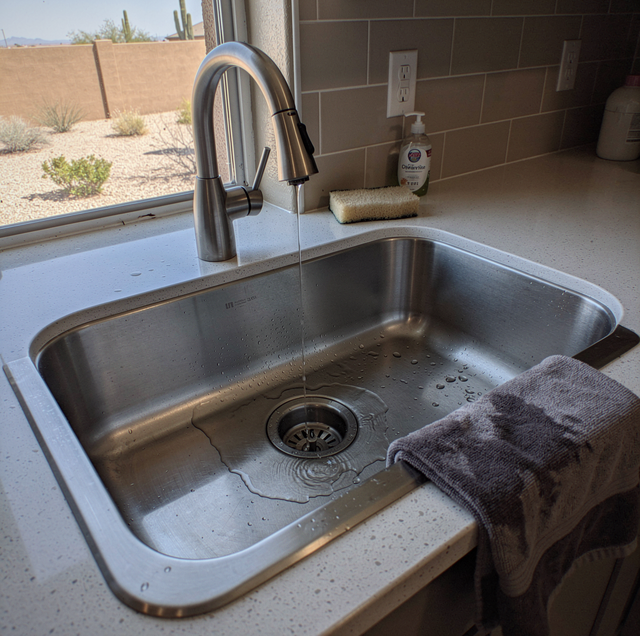
A faucet that keeps dripping from the spout has a shutoff seal that no longer closes completely: a rubber part that has hardened or torn, or a hard surface that no longer sits flush against its mate. Which part it is depends on the kind of faucet you have, since the mechanism and the part that wears first differ by type.
Before You Start: First Steps
Work through these in order before anything under the handle comes loose:
- Shut the fixture's supply stops: A sink with stops has two small oval or lever handles under the basin, one hot and one cold; turn both clockwise until they stop. If a stop won't fully close or starts to leak when you turn it, end the job there and call a plumber.
- Plug the drain so nothing small is lost if the handle cap comes off: A stopper, a rag, or painter's tape over the drain opening keeps a spring, clip, or small screw from disappearing down the drain.
- Identify the faucet type: Pull the decorative cap off the handle and look at what's underneath before buying any part. The internal design, not the faucet's brand or finish, decides which repair kit fits.
Never force a stiff supply stop with pliers or a wrench. An old stop's stem or packing can break loose under full line pressure and flood the cabinet, so leave the fixture alone and have a plumber replace the stop.
Sorted by what stops the water and what wears first, the four designs compare like this:
| Faucet Type | How It Shuts Off | What Wears |
|---|---|---|
| Compression | Two separate handles; turning each stem screws a rubber washer down onto a metal seat until it blocks flow | The washer, and eventually the seat it presses against |
| Cartridge | A handle lifts, turns, or both, moving a sealed cartridge that lines up internal ports to start, stop, and mix the flow | The O-rings and seals inside and around the cartridge |
| Ball | One handle rotates a slotted metal or plastic ball over spring-loaded rubber seats to open and close the waterways | The seats and springs beneath the ball, and the ball's own rubber seals |
| Ceramic disc | A single handle turns two tightly fitted ceramic discs across each other to align or block the ports | The rubber seals beneath the discs; the hard disc faces resist wear |
Why a Faucet Drips: The Shutoff Part
Every faucet, regardless of type, is a valve, and each design stops water the same basic way: two surfaces press together to block a passage, and turning the handle drives them apart or brings them together. A drip means that seal is no longer complete, whether from a rubber part that has flattened, cracked, or picked up a nick from grit, or from a mineral deposit sitting between two surfaces that used to meet cleanly. A shutoff seal only works while the tap is closed, and that is when full line pressure sits against it, so a worn seal weeps between uses.
Compression Washers and Seats
A compression faucet is the oldest, simplest design still in wide use and has the fewest moving parts. Each handle threads its own stem down into the body, and at the bottom of that stem sits a rubber washer, held by a small brass screw, that presses onto a matching seat built into the faucet body. Turning the handle drives the washer onto the seat to stop flow; turning it back lifts the washer clear.
Two things wear here, in sequence. The washer goes first, since it's soft rubber flexing against metal on every turn, and a hardened or torn washer is the classic reason a compression faucet drips. A new washer of the matching size is the repair. If a fresh washer stops the drip only briefly before it returns, the seat itself has likely pitted or roughened, because a washer can't seal against a damaged surface, no matter how new it is. On very hard water, scale can build a rough film on that seat, so a new washer presses onto a rough face and the drip returns, which makes the seat the next suspect; where the supply runs soft, that film stays slight, and a returning drip points to seat wear rather than scale.
Cartridges
A cartridge faucet replaces the stem-and-washer system with a single sealed unit that slides into the faucet body. Lifting, turning, or both move the cartridge so that internal channels line up with the hot and cold ports, controlling flow and temperature at once in a single-handle design, or flow alone in a two-handle cartridge faucet. Because the mechanism lives inside one replaceable part, a cartridge faucet is repaired by swapping that part, fitted in the same orientation as the old one.
The O-rings and rubber seals around a cartridge are the parts that wear, and a cartridge can also wear inside, which is why the whole cartridge gets replaced. Those seals sit against the faucet housing, and once one hardens, water works past it in a slow drip even though the cartridge still turns smoothly. A cartridge that is hard to lift or turn, rather than one that simply drips, can indicate mineral buildup gripping the seals, or a cartridge that has dried out or worn, rather than a seal that has failed outright. On very hard water, scale can grip a cartridge's seals and coat the ports it slides across, so on that supply a stiff handle or a returning drip puts scale on the list of suspects; on soft water that film stays slight.
Ball and Ceramic-Disc Faucets
A ball faucet uses a single handle to rotate a hollow metal or plastic ball inside the faucet body. Slots cut into the ball line up with spring-loaded rubber seats pressed against it from below; rotating the handle either aligns the slots with the seats to let water through or turns them away to block it. That single-handle design still carries several separate seals: two seats, two springs, and O-rings around the ball stem, any one of which can be the source of a drip.
A ceramic disc faucet solves the same problem differently. Two flat, hard discs sit face to face inside a cylinder, and turning the handle slides one disc across the other to open, close, or blend the ports beneath them. The disc faces resist wear, though grit can chip them. The rubber seals beneath the discs, where the assembly meets the faucet body, are another place a drip can start, and they fail the way any rubber seal does: age, hardening, or grit working into the seat.
A hard, smooth ceramic face gives mineral deposits little to grip. On very hard water, scale can still build up on the rubber seals under the discs and in the inlet ports feeding them, so, on that supply, a slow drip from a disc faucet calls for a look at those seals and ports as well as the discs; on soft water, that buildup stays slight.
When the Drip Comes from the Spout Tip or Somewhere Else
Where the water appears tells you which part to look at. A drip from the very tip of the spout, steady bead or slow weep, points back to whichever component controls flow through the body: the washer and seat, the cartridge, the ball and its seats, or the discs. That's the internal valve failing to seal.
Water appearing somewhere else changes the diagnosis. Moisture pooling under the sink at the supply connections is a different mechanism from a drip at the tip, even though both read as "the faucet is leaking." It points to fittings separate from the shutoff mechanism, and no amount of work on the washer, cartridge, ball, or discs will fix a leak occurring elsewhere in the fixture.
Repair or Replace the Faucet
Repairing a single-mechanism drip makes sense when the fixture is otherwise sound. A washer, a cartridge, or a seat kit is a contained job, and it keeps a faucet that still matches the rest of the room's fixtures. Replacement starts to make sense once a faucet needs more than one part at once, once the body shows corrosion or pitting at the connections rather than worn internal seals alone, or once a discontinued design makes a matching part hard to source. A faucet already repaired more than once for the same drip, with the problem returning each time quickly, can mean the body or seat has worn past what a new soft part can seal against, that household pressure is overpowering the new seal, or that the replacement part was a near-match rather than the right one.
The decision also depends on what's behind the wall. A spout leak that turns out to be a failed supply-line connection, or corrosion where the faucet body meets its supply lines, takes the job beyond a single part, and that is work for a licensed plumber.
Frequently Asked Questions
Only for a while. Cranking the handle down crushes the worn washer against the seat, which can briefly quiet the drip, but it flattens the washer further and can score the seat, so the drip returns with a damaged seat added to the repair. A compression handle needs only light pressure just past the point where the flow stops.
Cartridges are matched to a specific faucet line by more than outward shape. The spline count where the handle attaches, the overall height, and the internal port spacing can differ between faucet lines and even between generations of the same faucet, so a cartridge that looks like a match on a shelf can still fail to seat or control temperature correctly once installed. Carrying the old cartridge along to compare side by side avoids that mismatch.
No. On a swivel spout, a leak where the spout meets the body traces to the O-ring sealing the spout collar as it swivels, not to the internal valve that controls flow. That O-ring can dry out from repeated swiveling even while the washer, cartridge, ball, or discs are still sealing perfectly, so replacing the internal parts won't touch a spout-collar leak.
Not always. Water left in the spout and in the aerator screen at its tip drains out after the valve closes, so a few drops right after shutoff can be normal. A drip that keeps going after the spout has emptied indicates the valve is failing to seal.
On some compression faucets, yes. A seat with light pitting can be ground flat in place with a seat-dressing tool, which is the method for seats built into the body; a removable seat is unscrewed with a seat wrench and replaced instead. A cracked or deeply grooved seat that can't be removed is a reason to replace the faucet.
Yes, and it's a separate failure from a spout drip. On compression and some other stem faucets, a packing washer or O-ring around the stem, held by a packing nut under the handle, keeps water from seeping up the handle shaft during use. When that seal wears, moisture shows around the base of the handle rather than at the spout, and the fix is to tighten or replace the packing, not the part that controls the water below it.
Schedule faucet repair for a drip that keeps coming back — the worn washer, cartridge or seat is traced and the fixture repaired or replaced to suit it. Norfleet Family Plumbing serves Mesa and the East Valley. Call (480) 681-1764.