
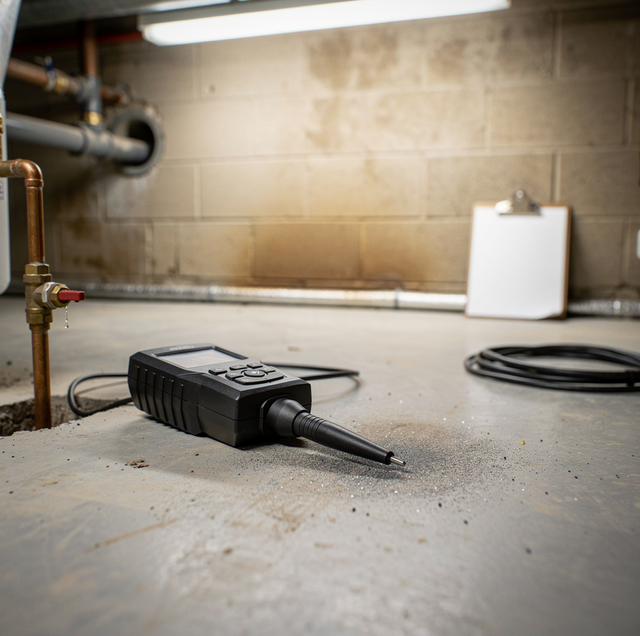
You've noticed the water bill jumped and nobody in the house can point to why. There's no puddle, no wet drywall, nothing obvious to trace. The hard part is not knowing where the water is going, which makes "just open up the floor and look" feel like the only option. It isn't. A plumber locating a hidden leak follows a set sequence, moving from confirming the leak exists to narrowing down which part of the system it's in to pinpointing the exact spot with equipment built for that job. Opening the floor comes last, and only at one specific location.
Confirming the Leak Is Real Before Anything Else Happens
A toilet flapper that lets water seep past the flush valve, an ice maker line with a slow drip inside the wall, and an irrigation controller stuck mid-cycle can each move the water meter the same way a broken supply pipe does, so ruling each one out comes first. With every fixture and appliance off and the main valve left open, a meter indicator that keeps turning confirms water is leaving the system somewhere. Closing the house-side valve then splits the buried service line from everything inside: still turning means the loss is in the buried run, stopped means it is in the house. This part of the process rules things out; it doesn't yet say which pipe or where along its length it is, only that a hidden leak is real.
Splitting the System: Hot From Cold, Inside From Outside
Every house has more than one water line, and each shutoff point along the way splits the system in half. Closing the valve at the top of the water heater isolates the hot side from the cold side; if the meter stops moving with that valve closed, the leak sits somewhere in the hot-water piping, not the cold.
Each of these tests removes one branch of the plumbing from consideration, and the leak has to sit in whatever's left. A leak isolated to the hot side points toward the water heater and the lines running from it. None of this pinpoints a location yet, but it turns "somewhere in the house" into a specific line, which is what makes the next step possible at all.
Narrowing the Zone Without Cutting Into Anything
A home built on a raised foundation over soil that holds its shape gives a technician a crawl space to work with, and following an isolated line by hand through that space, checking for a damp joist or a dripping fitting, can locate a leak with nothing more than eyes and a flashlight. That option depends entirely on having a cavity to get into.
Slab-on-grade construction removes it. The line in question runs through or under a poured concrete slab, with no gap to open and look into by hand, and a slab on expansive clay is the combination where slab leaks are a real concern. For a home built this way, visual tracing isn't an option the way it is on a raised foundation over stable ground. That's the point where the process shifts from isolating a branch of pipe to pinpointing an exact spot along it with equipment, because guessing at a location and opening concrete on that guess risks cutting in the wrong place entirely.
Listening for the Leak Under a Slab or Behind a Wall
Water escaping from a pressurized line makes a sound at the point it exits the pipe, and that sound travels outward through the surrounding concrete, soil, or framing. A ground microphone or a contact sensor placed at intervals along the isolated section picks up that sound and compares its intensity from one listening point to the next. The point where the sound is loudest and where it fades in both directions as you move away from it marks the leak.
This method works whether the pipe carries hot or cold water, and it works through concrete because the sound itself is detected, not any visible surface sign. It has one real limitation: background noise from traffic, appliances, or the house itself can mask a faint leak, so acoustic listening gets paired with a second method rather than trusted alone to mark the exact cut point.
Reading Heat to Find a Hot Water Line's Break
A leak on the hot side of the system carries heat with it as it escapes, and that heat transfers into the surrounding concrete or wall material, changing its surface temperature. An infrared camera reads that temperature difference across a floor or wall and displays it as a visible outline, which narrows a suspected hot-water leak to a specific patch rather than a general area, though a cold-water line running through the same slab gives little or no heat signature to read, which is why thermal imaging is mainly a hot-line tool.
Tracing a Cold Line With Gas Instead of Heat
A cold-water leak needs a different signal to follow, since there's no heat difference to read. With the suspect section of pipe isolated and drained, a technician introduces a small volume of a nontoxic tracer gas, a nitrogen-and-hydrogen mix, into that section under pressure. The gas follows the same escape route as the water, through the same crack, up through the same soil or concrete pores, to the same surface.
A handheld sensor tuned to detect that specific gas is then swept across the floor or wall above the suspected run. The sensor detects a concentration spike directly above where the gas is escaping, which is the same point where the water has been escaping all along. Because the gas rises through the material rather than depending on sound transmission, this method can pinpoint a location in situations where background noise or a particularly quiet leak makes acoustic listening unreliable on its own.
Confirming One Spot Before Anyone Opens the Floor
A single method pointing to a location is a strong lead, not a decision to cut. Acoustic listening, thermal imaging, and gas tracing each have a specific weakness: sound can be masked, heat mainly applies to hot lines, and gas tracing requires draining and isolating a section first. A moisture meter run across the surface adds a fourth check, indicating how far a wet zone has already spread through the material rather than directly pointing to the leak's source, which is useful for confirming that a suspected spot lies within the saturated area rather than at its edge. Running two or more of these against the same suspected zone and confirming they agree on the same spot is what turns a strong lead into a location worth opening.
That cross-check matters because a mistaken cut into concrete is expensive to correct and disruptive, regardless of the outcome: a wrong guess opens a section of the floor that has to be patched and repaired on top of whatever repair the actual leak still requires. Confirming with a second method before marking the spot keeps that risk to a minimum.
Opening the Floor Only Where the Line Is Broken
Once two independent methods agree on a location, the subsequent cut is small and specific to that spot, not a slab-wide excavation. A section of concrete roughly the size needed to expose the pipe and work on it is raised; the break is exposed, and the repair happens right there, whether that means replacing a short section of pipe, rerouting around the damaged run entirely, or repairing the failed fitting.
The floor is then patched back over that same footprint. Every other section of the slab stays untouched because the entire sequence before this point exists to ensure that the only concrete that comes up is the concrete directly over the actual problem.
Frequently Asked Questions
The equipment listens for the same escaping-water sound in both cases, but PEX's flexibility dampens that sound differently than rigid copper does, resulting in a duller signal rather than copper's sharper transmission. A technician working on a PEX system checks more points along the suspected run before marking a location to compensate for that weaker signal.
Hydrogen alone would carry a fire risk, so the mix is mostly nitrogen with only a small share of hydrogen blended in, a combination classed as nonflammable. That small share still does the job, because the hydrogen molecule is small enough to pass through the same concrete and soil pores the escaping water already works its way through.
A small transmitter can be fed into the accessible end of the suspect line, and a receiver swept across the surface picks up the signal the transmitter emits as it follows the pipe's exact path. That traces one specific line separately from any other pipe running nearby, which matters when several lines share the same trench or wall cavity.
No. A video camera run through a line is standard for a drain or sewer pipe, where the camera can travel through open, unpressurized pipe and show a crack or blockage directly on a screen. A pressurized water supply line is too narrow and completely full of water to run a camera through, which is why supply-line leaks are found by sound, heat, or gas rather than by a camera.
Isolating a section and pressurizing it with air, then observing whether a gauge holds steady or drops, is a standard way to confirm that a leak exists somewhere in that section. It confirms the presence of a leak within a defined stretch of pipe rather than pinpointing the exact spot, as acoustic listening, thermal imaging, or gas tracing does.
The repaired section is brought back up to full system pressure while the cutout or trench remains open, before any concrete or soil is placed over it. Confirming the new fitting or coupling holds under that pressure, with the area still exposed, means a slow leak at the repair itself gets caught and fixed on the spot instead of after everything is closed back up.
Locate a hidden leak without guesswork — get it pinpointed with electronic leak detection before anything is opened. Norfleet Family Plumbing serves Mesa and the East Valley. Call (480) 681-1764.