
The house is quiet at one in the morning, every tap is closed, and somewhere behind a wall or under the floor there is water moving. Not a drip. A thin trickle, or a hiss that fades the moment you stand still to locate it and returns as soon as you give up.
Two completely different situations make that sound, and your ear cannot tell them apart. In one, water is leaving your plumbing. In the other, water is moving and not a drop is being lost. One reading at the meter separates them.
Read the Meter Before You Chase the Sound
Shut the house down first. Close every faucet, and turn off the ice maker, the water softener, and any filtration or humidifying equipment that draws water on its own schedule. Set the irrigation controller to off rather than trusting its next program is hours away. Anything that can call for water on a timer will forge a leak signature that is not a leak.
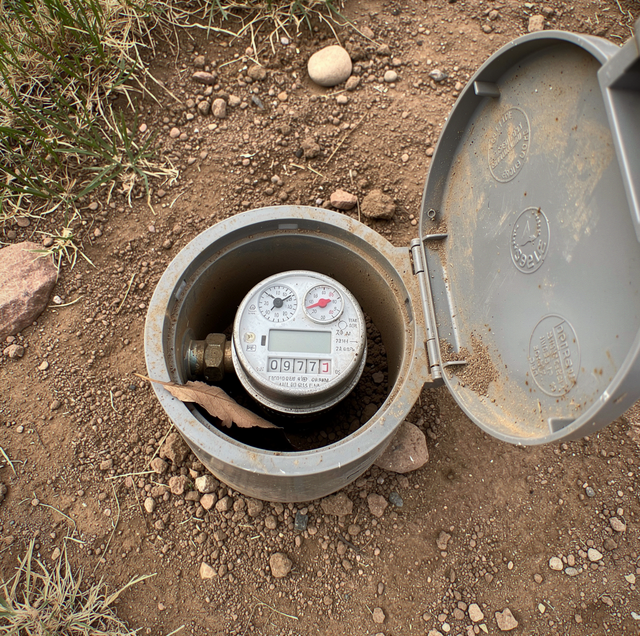
Then find the meter. In most houses it sits in a lidded box at the front of the property near the street, sometimes in a wall recess in attached builds. Under the lid, past the register that counts gallons, sits a small separate indicator: a triangle, a star-shaped wheel, or a red dial that turns on any movement at all. That is the part to watch, not the digits.
That indicator exists because of gearing. The register totalizes household volume and is tested for accuracy down to roughly a quarter gallon per minute, while a leak far smaller than that still spins the small dial. Watch it for a full minute without touching anything.
If that indicator creeps with the house shut down, water is leaving the system and the rest of your search is a hunt for where. If it sits dead still and you can still hear water, nothing is being lost, and every cause worth considering lies on the other side of that fork.
Some meters make this hard: a box packed with dirt, fogged glass, or a digital unit that shows nothing until it wakes. Use the slow version. Photograph the reading, including the meter indicator if the meter has one, then leave the house untouched for 1 to 2 hours, and photograph it again. Any change is flow you did not create.
A Running Toilet Is the First Thing to Rule Out
By a wide margin, this is the answer, and the one people dismiss first, because they walk into the bathroom, hear nothing, and move on.
A flapper that no longer seals lets tank water slide down the flush valve seat and over the glazed side of the bowl. No splash, no ripple, so the leak itself is silent. What you hear is the fill valve cutting in every few minutes to replace what was left, running fifteen seconds, and shutting off again. A slow enough leak will not trigger it for long stretches, which is why the sound comes and goes with no predictable pattern.
The dye test settles it. Put a dye tablet or a dozen drops of food coloring in the tank, leave the lid off, and do not flush. Wait 10 to 15 minutes and look in the bowl. Any color there means water is passing the flapper. Check the overflow tube too: a fill valve set high enough to send a stream down it runs the toilet nonstop, and that fix is an adjustment rather than a part. A faucet or showerhead weeping past a worn cartridge moves the meter the same way, but that one announces itself at the fixture.
An Irrigation Zone Can Run All Night Without Anyone Seeing It
Irrigation is the one water-using system in most homes that operates on its own authority, and programs commonly run before dawn to cut evaporation losses, which is exactly when the house is quiet enough for you to hear the line feeding them.
Two failures look alike at the meter. A controller program you forgot about runs a zone for its scheduled minutes, or a zone valve fails to seat, its diaphragm held open by grit, and weeps between programs. Either way, the water goes into the ground, and by the time you walk the yard in daylight, the surface has dried. Set the controller to off and repeat the meter test. If the indicator stops, the loss sits downstream of the irrigation valves.
A Service Line Leak Shows at the Meter and Nowhere Else
Between the meter and the point where water enters the house runs a buried length of pipe, and a leak there gives the strangest version of this problem: the meter turns steadily, nothing inside is wet, no fixture is running.
You can narrow it. Most homes have a shutoff on the house side of the meter and another at the point where the service line enters the building. Close the one at the house and watch the low-flow indicator. If it keeps turning with the house isolated, water is escaping between the meter and the closed valve in the buried run. If it stops, the loss is inside. Where responsibility for that pipe begins and ends is a question for your water provider.
A supply line failing beneath a slab produces the same continuous hiss even when nothing is wet, because the water saturates the gravel and soil beneath the concrete before it reaches any surface. That is a diagnosis in its own right, and it starts the same way: at the meter.
A Water Heater's Relief Valve May Be Discharging
Every tank heater carries a temperature and pressure relief valve piped down toward the floor or into a drain. When it opens, water leaves the tank, runs down that pipe, and the heater refills. The meter moves, you hear water running, and nothing is visible leaking because the discharge is going exactly where it was designed to go.
This is a real finding rather than a nuisance. The valve is a safety device set to open at roughly 150 psi or 210 degrees, and it opens for one of two reasons. Either pressure climbed to that threshold, which happens when heated water expands and a check valve, backflow preventer, or pressure-reducing valve at the meter blocks the path back toward the street. Or the temperature climbed, which suggests a thermostat or gas control didn't shut the burner off. The first is a pressure condition the whole house has, and the remedy sits on the pressure side rather than at the valve. The second is a heater that needs attention now.
A relief valve discharges water at tank temperature under system pressure, and a lever that will not reseat turns a drip into open discharge. Never lift the lever on a valve you suspect is failing, and never plug, cap or tighten one.
When the Meter Is Still, the Sound Is Real, but Nothing Is Lost
Water moves without leaving, and six sources cover nearly all of it.
Thermal Expansion and Pipe Movement
A hot line that goes from 70 degrees to 130 degrees gets physically longer. Copper expands about 1 inch per 100 feet for every 100 degrees of temperature rise, and PEX expands several times as much. A run passing through a drilled joist or a tight strap has to release that length somewhere, so it sticks, slides, and sticks again. The result is a tick or a soft trickling that is not water flow at all, and it continues while the line cools.
A Recirculation Pump Running on a Timer or an Aquastat
A recirculation loop keeps hot water moving through the pipes so it is already waiting at the fixture. The pump is small, usually mounted at the heater, and when it runs, it sounds precisely like a tap left open in another room. Timer models run at set hours; aquastat models start whenever loop temperature falls below a setpoint, which is how the sound starts at three in the morning. That water never crosses the meter.
Air in the Lines and Water Hammer Arrestors
After any work that drained part of the system, air returns to the pipes and works its way out through fixtures over the following days. Trapped air gurgles and shifts whenever pressure fluctuates, a fair impression of running water. Water hammer arrestors are sealed chambers holding a cushion of gas behind a piston, and a waterlogged one stops absorbing shock, so valve closures produce a bang that travels a wall.
A Neighboring Unit's Plumbing in a Shared Wall
In a duplex, townhome, or condo, the pipe in the party wall conducts sound extremely well. A shower or a toilet refill on the other side arrives in your bedroom as water running inside your wall, because in a sense it is. The tell is timing you do not control, on hours that match someone else's routine.
A Condensate Line or an HVAC Drain
An air conditioner pulls moisture out of the air; that water collects in a drain pan, and it leaves through a three-quarter-inch line that usually ties into the drain system. This is genuine running water on a real pipe, often in the same wall chase as the plumbing, with no connection to supply pressure, which is why the meter cannot see it.
A Well Pump or Pressure Tank Cycling
On a well, there is no utility meter to read, so the fork moves: watch the pump. A pressure switch typically cuts in around 30-40 psi and cuts out at 50-60 psi, and the pump refills the tank between those points. If it cycles when nobody is using water, either something downstream is losing water or the tank has waterlogged and lost its air charge, causing the pump to kick on and off in bursts.
What to Do Until Someone Can Look at It
If the meter is moving and the toilets, irrigation, and heater discharge pipe have all been ruled out, the next step is containment rather than diagnosis. Know where the main shutoff is. It is usually one of two places: on the house side of the meter in the box at the street, or where the service line enters the building, on a garage wall or in a utility closet. Two in the morning is the wrong time to learn the answer.
Turn the main shutoff all the way closed and back open once while nothing is wrong. An old gate valve that has not moved in years often seizes or drips at the stem the first time it is asked to close.
Two situations call for stopping. Standing water near the electrical panel, a subpanel, or the wiring at an electric water heater is not something to investigate on your own. And a relief valve actively discharging is something you observe and report, not a part you open or dismantle.
Frequently Asked Questions
Enough that it reaches the bill long before it reaches the floor. Federal water-use estimates put a leaking toilet at up to 200 gallons a day, and put household leaks nationwide at nearly 1 trillion gallons wasted each year, with roughly 10 percent of homes losing 90 gallons a day or more.
It could. Softeners regenerate on a schedule set for the early morning hours when nobody is drawing water, and a cycle runs anywhere from about an hour to well over two while the unit backwashes the resin bed and rinses brine to the drain. Above 10 grains per gallon, that may happen every few days rather than weekly.
Yes. A tank loses heat through its walls and flue continuously, so the thermostat calls for a standby reheat several times a day whether anyone showers or not. On a heater carrying scale, that reheat brings rumbling and popping as water trapped beneath the deposits flashes to steam.
It can. A worn PRV passes water across its seat and may chatter or hum as the diaphragm oscillates against changing street pressure, and that sound carries through the cold side of the house. Most residential units are set around 50 to 60 psi and drift after roughly 10 to 15 years. Neither failure loses water, so the meter stays still.
Usually not. Both fill and drain on timed cycles, so a dishwasher takes on water partway through a run, and a washer can refill for a rinse after you assume it is finished. An ice maker is quieter still: its fill valve opens for roughly 7 to 15 seconds per harvest, several times a day.
Give it several minutes. Closing the main empties nothing: the piping and the heater stay full under residual pressure, and a 50-gallon tank plus the branch lines holds enough to keep a small leak going after the supply is cut. If the sound is unchanged 10 minutes later, look at the drain side, the condensate line, and the other side of a shared wall.
Book a leak diagnosis while the sound is still happening — a technician can confirm what the meter is telling you and find where the water is going. Norfleet Family Plumbing serves Mesa and the East Valley. Call (480) 681-1764.