
Stand on the strip of ground between your house and the street, and look at what sits on it. Your drive crosses it. So does the irrigation manifold, the mature tree whose roots found the sewer lateral in the first place, and one corner of your patio slab. Under all of it, one line runs from the foundation to the city main, and if it has started backing up into the house, that line has to be put right, and everything on top of it stands between a crew and it.
The difference is not really about digging. It is about what happens to the pipe already down there, and the three methods each leave it in a different state. Which of them your line can take depends on the pipe's condition, and that condition only shows on video.
What an Open Cut Removes and Puts Back
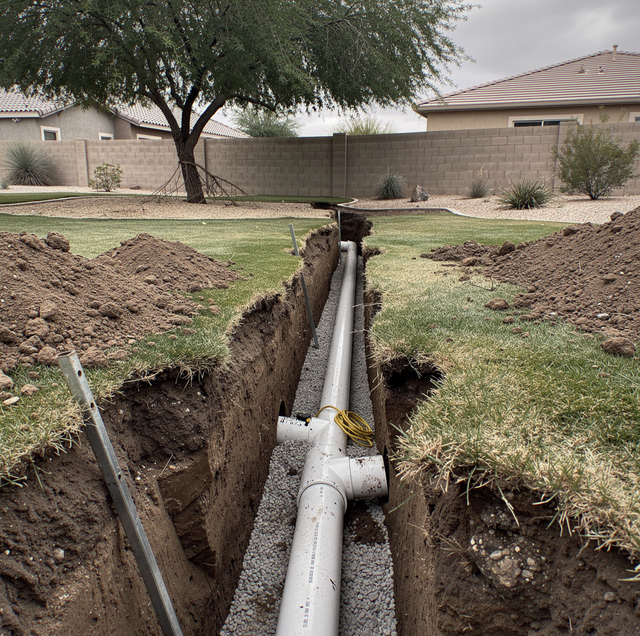
An open cut is the only one of the three that removes the old pipe from the ground. A machine opens a trench along the line's path, deep enough to reach the pipe's bottom and wide enough to work in. The failed run is cut free and hauled off. New PVC goes down on a bed of granular material, haunched along both sides so it bears all the way around rather than on two high points, then backfilled in lifts, each one compacted before the next.
That sequence gives you back the one thing neither trenchless method can offer: the grade and the position of your line. A length that had settled into a sag is re-bedded so it falls the right way again. A run passing under something you would rather it cleared can be shifted, and whatever diameter you want goes back in.
What you give up for it is the trench. Open ground has to be fenced off from people and pets for the length of the job, and a wall of loose soil standing on its own, with no shoring, benching or sloped sides, can come in on whoever is at the bottom of it.
Pipe Bursting Splits the Old Line and Leaves It in the Soil
Bursting starts with a steel cable rodded through the existing pipe end to end. A cone-shaped bursting head wider than the pipe it enters goes on the lead end, and a hydraulic unit hauls it back along the line. The old pipe fractures outward against it and the pieces are pushed into the soil around them. Nothing leaves your yard; the shards stay in the ground as a shell.
The new pipe follows immediately behind the head, making it a single pull instead of a dig-and-lay. That pipe is HDPE, joined by butt fusion: the ends are faced square, heated against a plate until the material is molten, then pressed together and held. What comes off the machine is one continuous string with no bells, no gaskets, and no joint for a root to work into.
Because the cone is larger than the host, a pull can put a bigger line in than came out, taking your four-inch lateral up to six. That displacement is also its limit. Soil has to have somewhere to go, so a shallow run can heave the ground above it, and a gas or water line crossing close alongside sits inside the zone your new pipe pushes into.
A Cured Liner Uses the Old Pipe as a Form
Lining removes nothing and breaks nothing. The old pipe stays put and becomes the mold the new one is shaped against.
The line is cleaned first, and that step is not optional: roots cut back, scale and grease stripped off, the wall left bare, because the liner has to press against pipe rather than a layer of debris. Then a tube of felt or fiberglass is saturated with resin, epoxy, polyester, or vinyl ester, and put into your line one of two ways. It can be inverted, turned inside out by air or water pressure so the resin-wet face rolls onto the pipe wall as the tube advances, or winched in dry-side-out and pressed against the wall by an inflated bladder. Either way, it is held under pressure while the resin hardens, cured by ambient temperature, hot water circulated through it, steam, or an ultraviolet light source drawn through the middle of it.
What you are left with is a jointless pipe inside your old one, bonded to it along its whole length, and branch connections that got covered over are cut back open with a robotic cutter. What a liner cannot change is where the host pipe sits, because it takes the host's shape exactly.
What Does the Camera Have to Show Before Trenchless Is an Option?
The choice gets made on video, before anyone names a method. A camera goes in at a cleanout, runs your lateral to the main, and the technician watching the monitor takes the run in the order the pipe allows, because nothing later can be graded until the thing before it holds.
Reach comes first. If the camera stops forty feet out, everything beyond is unknown, and nobody commits to trenchless over ground no one has seen. Passage comes next: a liner tube or a bursting cable is thicker than the head that got down there, so a bore that admitted a camera can still refuse both.
Then come the defects that rule methods in and out. An offset joint, where one pipe end has dropped or slid sideways, leaving a lip in the bore, stops a tube and catches a cone. Where water is standing, that length of your line has lost its fall. The root mass is cut out before the rest can be judged.
One more thing happens on that run. The camera head carries a sonde, a transmitter a walk-over locator picks up from the surface. That is how a crew paints the line's position and depth onto your grass, and whether a pit lands in turf or under your drive.
Where the Ground Gets Opened and What Comes Back
A bursting job needs two pits rather than a trench: one at the house end near the cleanout, and one at the far end by the main or the property line. Everything between stays closed. A lining job can need no excavation at all, because where there is a serviceable cleanout, the tube goes in through it.
That difference falls hardest on a lot with things built over the line. A pit is a hole you can position within a few feet, so it can sit in your turf even where the pipe runs under concrete. A trench has no such freedom; it follows the pipe, which means through your drive if the drive is over it.
Restoration is the other half. Turf comes back in a season. A saw-cut concrete panel is replaced as a whole, and new concrete cures to a shade that will not match a slab that has weathered in full sun for fifteen years. Backfill not compacted in lifts keeps settling after the crew leaves, so the trench line reappears as a shallow depression across your yard. Ground carrying a cemented caliche layer cuts slowly and holds a vertical face well, which tempts a crew to leave a wall unsupported.
What the Old Pipe Is Made Of
Whether a cone can be pulled through your line at all depends on what your pipe is made of.
Vitrified clay is brittle and fractures cleanly, which is the behavior a bursting cone is built around; its weakness in service, the mortared or gasketed joint every few feet, is exactly where roots got in. Cast iron corrodes from the inside out, and by the time a lateral is failing,s the wall has thinned enough that it breaks rather than bends. Orangeburg is the odd one: bituminized fiber pipe, wood pulp layers rolled into a tube and bound with coal tar pitch, which goes oval under load and delaminates rather than cracking. It comes apart under a cone with very little persuasion. Solid-wall ABS is the one on that list a cone does not simply crack: it is a thermoplastic, solvent-welded at the hubs where clay relies on a gasket, and at soil temperature it is tough enough to fold around a head rather than part.
Ductile iron and steel are the pair that changes the tooling. They yield around the cone and close back on it instead of shattering, so splitting those lines calls for a rolling-blade head that slits the wall with cutter wheels as it travels, rather than an expander relying on the pipe to break apart on its own.
Frequently Asked Questions
Not in the way you would want. A liner hardens to the shape of whatever it is pressed against, so a length that has lost its fall still sags once the resin sets. The standing water in it is a second problem: inflation pressure has to drive it out ahead of the tube before the cure begins, or the resin sets against water instead of pipe wall. Getting your fall back means opening that length and re-bedding it.
It gives your tree a far better chance than a trench does. A project arborist writes the tree protection plan to protect trees during construction, and sizes the critical root zone as a radius from the trunk, a foot for every inch of trunk diameter. A trench cut across that circle severs structural roots down one side of the plate, while a bursting pull disturbs soil radially along the pipe. Ask where your pits will land against that circle.
The clock on a trenchless job is chemical more than mechanical. Once a liner tube is saturated, the resin's working window has started, and that window is short, which is why a tube is wet out and inverted the same day it reaches your house. During a bursting job, each fused HDPE joint is clamped during cool-down before the string can take a pulling load. Your day is built around those two waits.
Only if something can get past the collapse. A liner tube needs a bore to advance along, a bursting job needs its cable rodded end-to-end, and a caved-in section admits neither. One resolution is a single small excavation directly over that point to clear it and give the cable a route through, with the rest of your line done trenchless from your pits.
Not where there is an exterior cleanout, because both trenchless methods launch through one. The fitting worth knowing by name is the two-way cleanout: two directional openings, one aimed back toward the house and one toward the main, so a camera or a tube can enter in either direction from the same point. If your property has no exterior cleanout, putting one in becomes part of your job.
It takes some diameter off your line, less flow than that sounds like. A nominal 3-millimeter cured wall is about an eighth of an inch, and counting both sides, that is close to a quarter inch off a four-inch line. What you get back is a smooth resin surface, with Manning's roughness near 0.010, compared to roughly 0.013 for tuberculated cast iron, which puts full-bore capacity about 10 percent ahead.
If the line between your house and the main has never been on camera, that run comes first — the offsets, the standing water and the joint condition down its whole length, which is the go or no-go on trenchless, and which no amount of watching your drains from inside the house will settle. Norfleet Family Plumbing serves Mesa and the East Valley. Call (480) 681-1764.
