Tank vs Tankless in a Hard-Water Home: Which to Choose?
Quick Answer: In a hard-water home, both tank and tankless water heaters are affected by mineral scale, but differently. A tank collects sediment at the bottom that must be flushed to protect the burner and capacity, while a tankless unit develops scale inside its narrow heat exchanger that requires periodic descaling. Tankless offers endless hot water, a longer lifespan, and space savings but costs more upfront and is more sensitive to scale without maintenance or a softener. A tank is cheaper to install and simpler but runs out and wears faster in hard water. The deciding factors are your hot-water demand, your willingness to maintain the unit, and whether you treat the water with a softener.
Choosing between a tank and a tankless water heater is common, and in a hard-water area, the minerals in your water deserve a place in the decision. Hard water affects both types, but in different ways and different places. Understanding how each handles hard water — and what upkeep each needs — helps you choose the heater that fits your home and your maintenance habits.
How Hard Water Affects Each Type
Hard water is loaded with dissolved minerals that come out as scale wherever water is heated. Both heater types deal with that, but in different spots.
In a tank heater, minerals settle to the bottom as sediment. Over time, that layer insulates the burner, slows recovery, eats into capacity, and stresses the steel. The defense is flushing the tank regularly to clear the sediment.
In a tankless heater, water is heated as it rushes through a narrow heat exchanger, and scale builds on the inside of those small passages. Because the channels are tight, scale has an outsized effect — it reduces efficiency, restricts flow, and can shorten the unit's life if ignored. The defense is periodic descaling, which in hard water is arguably more critical than the flushing a tank needs. Many tankless owners in hard-water areas pair the unit with a water softener to protect it.
The Core Trade-Offs
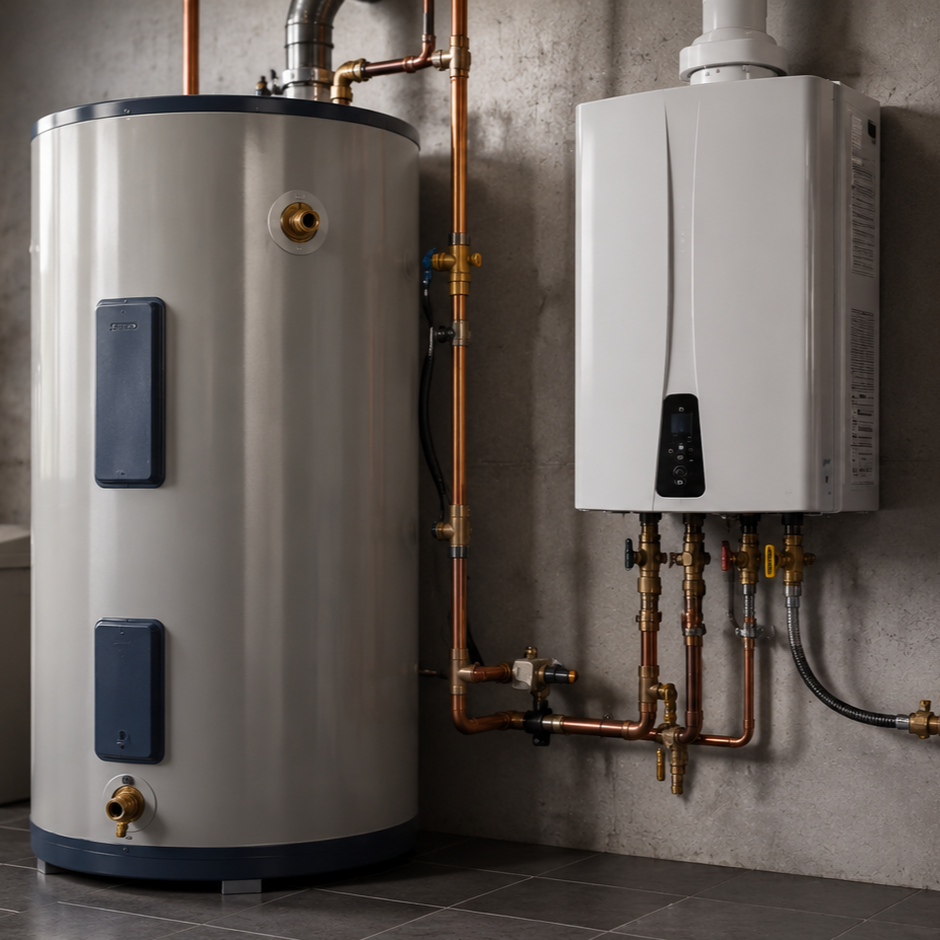
Setting hard water aside, the two differ in familiar ways. A tank stores a set amount of hot water — simple and lower-cost to install, but it can run out under heavy use and takes up floor space. A tankless heater heats water on demand, so it never runs out and saves space and energy, but it costs more upfront, may require gas or electrical upgrades, and has a flow-rate limit that can be strained when several fixtures run at once.
| Factor | Tank (hard water) | Tankless (hard water) |
|---|---|---|
| Where scale collects | Sediment at the bottom | Inside the heat exchanger |
| Required upkeep | Periodic flushing | Periodic descaling |
| Sensitivity to hard water | Wears faster if unflushed | Performance drops fast if unscaled |
| Hot water supply | Limited by tank size | Endless, flow-rate capped |
| Lifespan | About 8–12 years | Often 20+ years |
| Up-front cost | Lower | Higher |
| Pairs well with softener | Helpful | Strongly recommended |
Maintenance Is the Deciding Factor
In soft water, the choice is mostly about supply and budget. In hard water, maintenance commitment becomes central. A tankless unit can deliver its long life and efficiency only if it's descaled on schedule; neglected in hard water, it can underperform and wear out far sooner than its potential. A tank is more forgiving of an occasional missed flush but still benefits enormously from regular flushing. If you'll keep up with maintenance — or install a softener to cut the scale at the source — a tankless unit can thrive even in hard water. If maintenance is likely to slip and there's no softener, a tank may be the more practical choice.
The Role of a Water Softener
A water softener changes the equation for both heaters by removing the minerals before they ever reach the unit. For a tankless heater, it's strongly recommended because it protects the heat exchanger and reduces how often descaling is needed, helping the unit reach its long lifespan. For a tank, it slows sediment accumulation and corrosion. With a softener in place, both heaters perform much closer to how they would on naturally soft water, which often shifts the decision back to supply, space, and budget rather than scale.
If you're leaning tankless in a hard-water home, plan for the maintenance that makes its long life real — a water softener and a regular descaling schedule. Budgeting for those up front is what turns the tankless lifespan advantage from a brochure number into an actual outcome in hard water.
Matching It to Your Home
Start with your demand: a household that often runs multiple hot-water fixtures at once or wants endless showers leans toward tankless, provided it's sized for peak use. Then weigh maintenance and water treatment honestly. A tankless unit in hard water rewards an owner who will descale it or soften the water with long life and endless hot water; it punishes neglect. A tank suits a simpler budget and a household comfortable with periodic flushing, accepting that it will run out under heavy use and wear somewhat faster in hard water. With a softener in place, either option performs much closer to how it would on soft water. A plumber can assess your water, usage, and habits and recommend the right fit.
Frequently Asked Questions
A tankless unit has a longer potential lifespan — often 20 years or more versus about 8 to 12 for a tank — but only if it's descaled regularly and ideally paired with a softener. Hard water builds scale in the tankless heat exchanger, and neglect erodes that advantage. A well-maintained tankless lasts longest, but a flushed tank can outlast a neglected tankless.
Because a tankless unit heats water in a narrow heat exchanger, hard water builds scale inside those small passages. Since the channels are tight, scale has an outsized effect — reducing efficiency, restricting flow, and shortening the unit's life if it isn't descaled. This is why regular descaling, and ideally a softener, are important for tankless units in hard water.
In a tank, hard water deposits sediment at the bottom, which insulates the burner, slows reheating, reduces capacity, and stresses the steel. Regular flushing clears the sediment and protects the heater. A tank is somewhat more forgiving of a missed flush than a tankless unit is of missed descaling, but neglect still shortens its life in hard water.
In a hard-water area, it's strongly recommended, especially with a tankless unit. A softener removes the scale-forming minerals before they reach the heater, protecting a tankless unit's heat exchanger and slowing sediment and corrosion in a tank. It reduces maintenance and helps either heater reach its full lifespan, so pairing a softener with your heater is a smart move in hard water.
More often than in soft water, the harder the water, the more frequent it should be. Installers and manufacturers give specific guidance, but in hard-water areas, descaling is a regular task, not occasional. A water softener significantly reduces how often it's needed by removing the scale-forming minerals at the source, which is why softeners and tankless units are often paired.
If you'll maintain it — descaling and ideally softening the water — a tankless unit offers the longest life plus endless hot water and space savings. If you want a lower upfront cost and simpler upkeep, a well-flushed tank serves its expected life. The deciding factor is the maintenance you'll realistically keep up with, since that determines real longevity in hard water.
Let Demand and Upkeep Decide
In a hard-water home, both tank and tankless heaters face mineral scale — sediment in the tank, scale in the tankless heat exchanger — and the upkeep each needs is the real deciding factor alongside your hot-water demand. A maintained tankless unit, ideally with a softener, delivers endless hot water and long life; a tank offers lower cost and simplicity with faster wear. Match the choice to your demand and your willingness to maintain it.
Choosing a water heater for a hard-water home? — Get sizing, maintenance, and softener guidance to pick the right one. Norfleet Family Plumbing serves Mesa and the East Valley. Call (480) 681-1764.
