
Signs Your Water Heater Is About to Fail
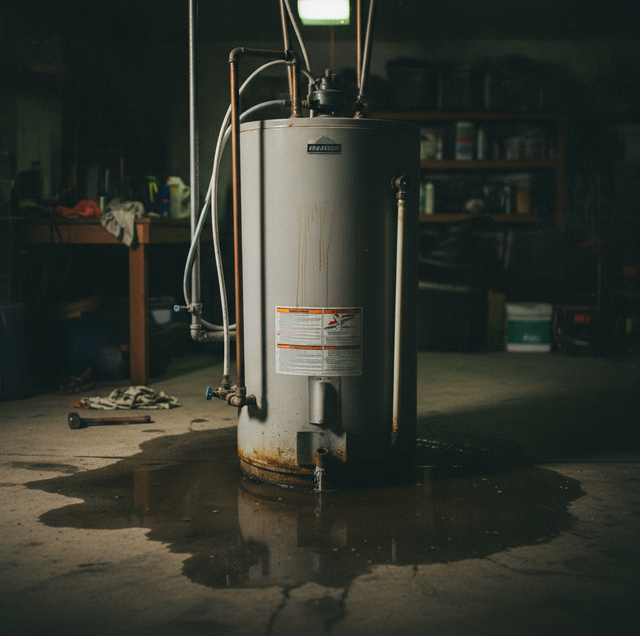
Nobody plans to replace a water heater. It happens to you, usually in the morning when it finally quits and hands you a cold shower, or in the afternoon when you find a spreading puddle around the tank in the garage. But a water heater almost never fails without warning. It drops hints for weeks or months at first, and in a hard-water area, it does so sooner than most people expect. Learn to read those hints, and you replace it on a calm Tuesday instead of scrambling after a flood.
Here are the signs, roughly in the order of how much they should worry you.
Water at the Base Comes First
Start with the most urgent one. If you find water pooling or damp spots around the bottom of the tank, treat it seriously. A leaking tank has usually failed structurally from the inside, and a small puddle can become a flood of dozens of gallons with little warning. Some moisture can come from a fitting or the drain valve, which is a simpler fix, but water at the base of the tank itself often means the heater is done. Shut off the water to it if you can and have it looked at right away, because this is the sign that does not wait.
Rusty or Discolored Hot Water: The Tank Is Corroding
When your hot water runs rusty, brown, or discolored while the cold stays clear, the tank is corroding from the inside. A steel tank is protected by a sacrificial anode rod that corrodes so the tank does not, and once that rod is spent, the tank itself starts to rust and colors the hot water. Rusty hot water is one of the clearest signs a tank is heading toward the end of its life, because a corroding tank eventually leaks. It is worth acting on rather than waiting to see how far it goes.
Rumbling and Popping: Sediment Has Built Up
A water heater that bangs, rumbles, or pops during its heating cycle is telling you sediment has collected and hardened on the bottom of the tank. Water trapped under that layer boils and forces steam up through it, making the noise. The sediment makes the heater work harder, wastes energy, and overheats the tank bottom, which shortens its life. Caught early, flushing the tank can clear it. In an older heater with years of buildup, the noise is often a sign that the unit is wearing out.
Fading Hot Water and Rising Bills: Losing Ground
Two quieter signs tend to arrive together. If you run out of hot water faster than you used to, or it never gets as hot as it once did, sediment has taken up space in the tank, or a heating component is failing, all of which cut the effective capacity. And if your energy use for heating water has crept up for no other reason, the heater is working harder to do the same job, usually because of that sediment insulating the tank. Neither is an emergency, but together they say the heater is losing ground.
Age: The Context for Everything Else
Behind all of these is the calendar. A conventional tank water heater generally lasts about 8 to 12 years, and once it is past that range, any of the symptoms above carries more weight. A heater in its second decade showing rust or noise is not a candidate for one more repair; it is telling you to plan its replacement. If you do not know its age, the serial number usually encodes the manufacture date.
| Sign | What it means | Urgency |
|---|---|---|
| Water is pooling at the base | The tank is leaking, likely failed | Now |
| Rusty or discolored hot water | The tank is corroding from the inside | Soon |
| Rumbling or popping | Hardened sediment on the tank bottom | Soon |
| Less or cooler hot water, higher bills | Sediment or a failing component | Monitor and plan |
| Past 8–12 years of age | Odds of failure climbing | Plan replacement |
Why Hard Water Ages a Heater Faster
In an area with very hard water, a heater lives a harder life than the general lifespan suggests. The heavy mineral load means sediment collects on the tank bottom faster, causing the rumble and the lost capacity sooner, and it uses up the anode rod that protects the tank more quickly, so the tank starts to corrode and rust the hot water earlier. Put simply, the same signs show up ahead of schedule here, which is why watching for them matters more, and why flushing the tank regularly and keeping an eye on the anode rod both help a heater reach the far end of its life instead of the near end. In hard water, prevention buys real time.
Frequently Asked Questions
A conventional tank runs about 8 to 12 years, but the part that sets that clock is the anode rod. That sacrificial magnesium or aluminum rod is engineered to corrode in place of the steel tank, and it is typically spent in 3 to 5 years, sooner in hard water. Once it dissolves, the tank has nothing left protecting it and begins rusting from the inside, which is the real start of the countdown. Checking and swapping the rod on that 3-to-5-year cadence is the single maintenance step that most extends tank life, and skipping it is why many heaters fail closer to 8 years than 12.
Not always, and the location of the water tells you a lot. Trace it upward first: the temperature and pressure relief (T&P) valve near the top can discharge down its tube and leave water at the base, and a stuck-open or weeping T&P valve is a repair, not a dead tank. That valve should be tested once a year by lifting its lever briefly to confirm it releases and reseats, since a T&P valve that fails to open is a genuine safety hazard on a tank building pressure. Damp only at fittings or the drain valve is also fixable. Water seeping from the tank shell itself, though, means the steel has rusted through, and that one does not wait.
Because only the hot side passes through the tank, rust forms at the points directly above a heater whose anode rod has failed, leaving the steel corroding. One quick way to narrow it down: if a fresh anode rod has been installed and the hot water still runs rusty after a few days, the corrosion has moved past the rod to the tank wall itself, which means the tank is failing rather than just due for maintenance. Worth ruling out is galvanized steel supply piping, which can also rust and tint water, but that usually discolors both hot and cold, not just the hot.
Often, you can flush it, and it helps to know why the noise matters beyond the sound. That hardened sediment layer sits between the burner and the water and acts as insulation, so the flame has to overheat the steel bottom to push heat through it, and that localized overheating is what cracks the glass lining and fatigues the tank. Draining and flushing the tank clears the layer if it is caught before it cements; a yearly flush keeps it from reaching that point. If years of buildup have fused into a hard cake that a flush will not move, the overheating is already doing damage, and the unit is near its end.
Yes, on two fronts at once. The mineral load drops more scale on the tank floor, which insulates and overheats the steel, and it eats the anode rod faster, so corrosion starts sooner. There is a performance cost too: as scale builds, it takes up volume and blankets the heating surface, so a tank that used to deliver plenty of hot water starts running out earlier, which is why a heater's first-hour rating, the gallons it can supply in the busiest hour, effectively shrinks over time in hard water. Flushing on a yearly schedule and adding a whole-home softener are the two moves that slow both the scaling and the anode loss here.
If it is past about a decade and showing signs like rust, noise, fading hot water, or any dampness at the base, replacing it proactively is usually smarter than waiting. A planned replacement avoids the cold showers and the potential flood of a tank that lets go, and it lets you choose the right unit without pressure. Reading the warning signs is what makes that possible.
Replace It on a Calm Day, Not a Flooded One
A water heater tells you it is failing before it quits: a damp base is the urgent one, rusty hot water and rumbling point to a corroding, sediment-filled tank, and fading hot water with rising bills says it is losing ground, all of it weighed against the heater's age. In hard water, those signs arrive early, so watching for them matters even more. Catch them, and you replace the heater as a planned job instead of an emergency with a cold shower and a soaked floor.
If your water heater is showing its age or leaking at the base, we can replace it on your schedule before it floods. Norfleet Family Plumbing serves Mesa and the East Valley. Call (480) 681-1764.
