
Water Heater Expansion Tank: The Part That Saves Your Heater
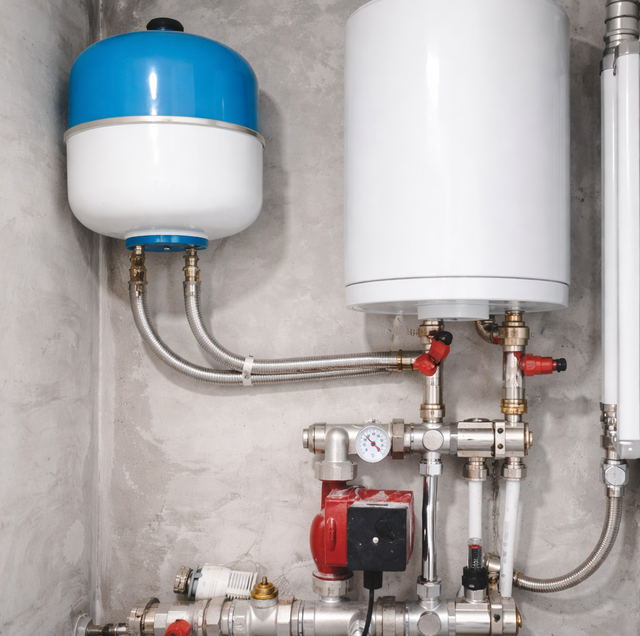
Quick Answer: A water heater expansion tank is a small tank with an air-charged bladder that absorbs the extra water volume created when your heater warms the tank. In a closed plumbing system, that expanding water has nowhere to escape and pressure climbs sharply. The expansion tank gives it a cushion, keeping pressure stable and protecting the heater, valves, and fittings.
That small football-shaped tank strapped to the pipe above some water heaters looks like an afterthought. It is quietly doing one of the more important jobs in the whole system: giving heated water somewhere to go so your plumbing does not turn into a slow-motion pressure cooker.
Not every home has one, and not every home needs one. The deciding factor is a piece of physics that happens every time your heater fires, combined with a valve on your main line that most homeowners never think about. Understanding both makes it obvious why one house drips a relief valve every evening while the identical house next door never does.
The Physics: Why Heated Water Pushes Back
Water expands when it heats. A typical 50-gallon water heater going from cold city-supply temperature up to a normal setpoint gains roughly half a gallon of volume. That sounds tiny, but water is essentially incompressible, meaning you cannot squeeze that extra half gallon into a smaller space. It has to go somewhere.
In an ideal world, the small surge simply pushes back through the cold supply line toward the street, and pressure barely moves. The water main acts like an enormous release valve for the whole neighborhood. When that path back to the street stays open, thermal expansion is a non-event and no expansion tank is required.
The problem starts when that escape route is blocked. Then the expanding water has no place to relieve into, and because it cannot compress, the pressure inside your pipes climbs fast, sometimes well past the point your fixtures were built to handle. Every heating cycle repeats the spike.
Open vs. Closed Systems: What Actually Traps the Pressure
Your home is either on an open system or a closed one, and the difference is a single component on your main line.
Open system: Water can flow freely in both directions between your house and the municipal main. When the heater expands, the surge travels back toward the street and dissipates. No trap, no spike.
Closed system: A one-way device on the main line stops water from flowing back out to the street. Three common culprits create this:
- A pressure-reducing valve (PRV), installed to tame high incoming street pressure, which usually only lets water flow one way, into the house.
- A backflow preventer, required to protect the public supply from contamination, which by design blocks reverse flow.
- A check valve on the main or at the meter, doing the same thing.
Any one of these seals your plumbing off from the street. Now the expanding water is trapped between that device and your closed fixtures, with no relief path. A house that was fine for years can become a closed system the day a water utility adds a backflow device at the meter, which is why relief-valve dripping sometimes appears seemingly out of nowhere.
What the Expansion Tank Actually Does
The expansion tank restores the cushion that a closed system took away. Inside its steel shell is a flexible rubber bladder or diaphragm. One side holds household water; the other side holds a sealed charge of compressed air.
Air, unlike water, compresses easily. When the heater fires and pushes out that extra half gallon, the water side of the bladder swells and squeezes the air pocket like a spring. The pressure rise gets absorbed into the air charge instead of slamming into your pipes and valves. As you draw hot water and the system cools, the air pushes the stored water back out, and the bladder returns to rest. It is a shock absorber for pressure, cycling quietly every day.
That is the whole trick: give the incompressible water a compressible partner to lean on, so pressure stays roughly flat instead of spiking with every burner cycle.
Symptoms of Thermal Expansion With No Tank
When a closed system has no working expansion tank, the trapped pressure shows itself in ways homeowners often misread as unrelated problems:
- A weeping temperature-and-pressure (T&P) relief valve: The T&P valve on the heater is a last-resort safety device set to open around 150 psi or 210 degrees. If it dribbles or spits shortly after the heater has run, that is often the pressure spike forcing it open. The valve is doing its job, but it was never meant to be the daily pressure regulator.
- Banging or knocking pipes as pressure surges stress the lines, sometimes mistaken for water hammer.
- Running or ghost-flushing toilets, because the raised pressure can push past worn fill-valve seals.
- Stressed supply lines, faucet cartridges, and fittings that wear out or seep well ahead of schedule.
- A shortened water-heater life, since the tank and its internal components absorb repeated pressure cycling they were not designed to take.
Never cap, plug, or screw a fitting onto a dripping T&P valve to stop the leak. That valve is a safety device against dangerous over-pressure and heat, and blocking it can turn the water heater into a serious explosion hazard. The drip is a symptom, so fix the cause rather than sealing the valve.
How an Expansion Tank Is Installed and Charged
An expansion tank is plumbed onto the cold-water supply line feeding the heater, typically within a few feet of the inlet. Mounting it on the cold side keeps the bladder out of the hottest water, which helps it last longer.
The step people skip is the pre-charge. Before water ever touches it, the tank's air side has to be set to match your home's static water pressure, read with a gauge at a hose bib. If your house sits at 60 psi, the tank gets pre-charged to about 60 psi so the bladder rests at neutral and has full travel to absorb expansion. A tank charged too low or too high cannot do its job and will fail early.
Support matters too. An expansion tank is light when empty but heavy once the bladder waterlogs or the tank is full, so it needs proper strapping or a bracket rather than hanging its weight on the supply pipe alone. An unsupported tank can fatigue and crack the fitting it hangs from. Because this ties into water-heater pressure, the T&P system, and often code requirements, it is pro- and code-governed work rather than a casual weekend swap.
Signs the Tank Has Failed
Expansion tanks wear out. The bladder eventually loses its air charge or splits, and once it does, the tank is just a dead-end pipe offering no cushion, so the old thermal-expansion symptoms return.
To check a suspect tank, tap it. A healthy tank sounds hollow and drum-like across the top half where the air charge lives, and duller across the bottom water side. If it sounds dull and solid all the way up, it is waterlogged, and the air charge is gone.
The second check is the air valve on the tank's end, which looks like a tire valve. Press it briefly. Air should hiss out. If water spits or dribbles from it instead, the bladder has ruptured and the tank is finished. Either result means replace it, and promptly, because a dead expansion tank leaves your closed system unprotected and the pressure cycling resumes against your heater and fixtures.
Failure is not a maintenance failure on your part. Even a well-installed tank cycles thousands of times a year, and the bladder is a wear part with a finite life. Very hard water and high household pressure both tend to shorten that life, so homes on aggressive water may see tanks age out sooner.
Who Actually Needs One
The short version: if your home is on a closed system, you need an expansion tank. If your main line has a PRV, a backflow preventer, or a check valve, expanding water is trapped, and a tank gives it the relief path it lost.
Homes on a truly open system, with unobstructed flow back to the street, may not require one, though incoming pressure and utility equipment can change that over time. In many areas, once a PRV or backflow device is present, an expansion tank is required by plumbing code, and inspectors look for it on water-heater installs. If you are not sure which camp your house falls in, the fastest answer is to have the main line checked for a one-way device and your static pressure measured. Those two readings settle it.
Frequently Asked Questions
Most last roughly 5 to 10 years, often shorter than the water heater it protects. Because the bladder cycles constantly and is a rubber wear part, a good habit is to test the tank's charge each year at the same time the heater's anode rod or overall condition is checked, rather than waiting for symptoms to reappear.
Sizing depends on your water-heater capacity and your incoming supply pressure, not on guesswork. A standard 40- to 50-gallon residential heater commonly pairs with a small 2-gallon-rated tank, but a larger heater or higher pressure calls for a bigger unit. An undersized tank runs out of travel and lets pressure spike anyway, so the sizing chart matters more than it looks.
It is possible, but the cold-supply inlet is the standard and preferred location. The cold side runs cooler, which extends bladder life, and it sits where the expanding volume first pushes back. Hot-side placement exposes the rubber diaphragm to the highest temperatures in the system and tends to age it faster.
No. It does not reduce your normal working pressure or flow at the tap. It only absorbs the temporary pressure rise caused by thermal expansion during heating cycles. If your faucet pressure is truly low, the cause lies elsewhere, often a clogged aerator, a failing PRV, or a partially closed valve.
Often yes, if the home is on a closed system, though the answer is less automatic than with a tank-style heater. Tankless units heat on demand and hold little water, so the expansion volume is smaller, but a closed system can still trap pressure. Some tankless installs include an internal buffer, so it comes down to the specific unit and the local code requirement.
Trace the main water line from where it enters the house or the meter and look for a bell-shaped brass PRV, a backflow assembly, or an inline check valve before the first branch. A second clue is behavior: if a hose-bib pressure gauge climbs on its own after the heater runs with no water being used, expansion is being trapped, which points to a closed system.
Chasing a dripping relief valve or banging pipes — let us check your pressure and expansion tank before it costs you a heater. Norfleet Family Plumbing serves Mesa, Chandler, and Gilbert. Call (480) 681-1764.
