
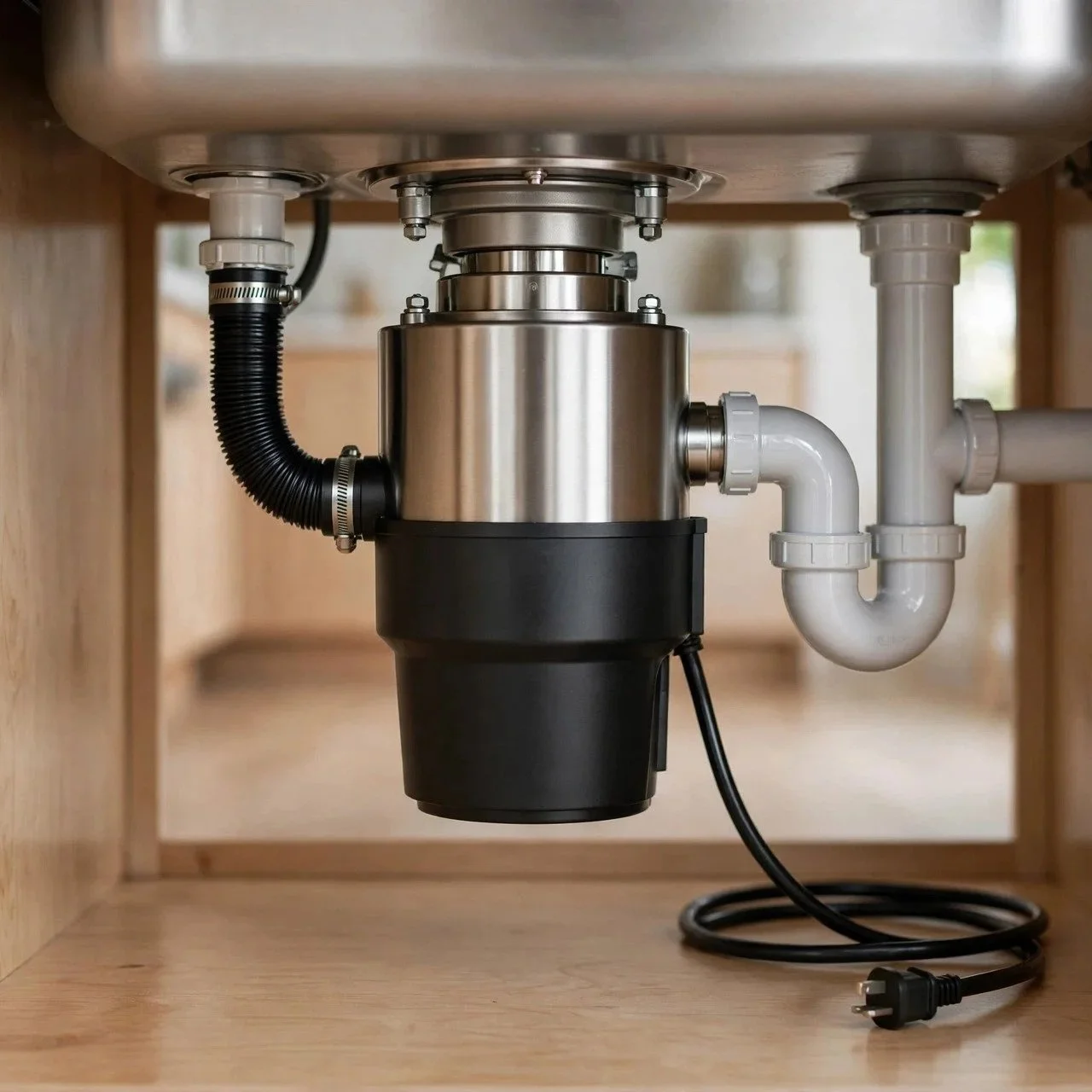
A dead garbage disposal feels like one problem, but it is really four different problems wearing the same disguise. The unit that sits silent when you flip the switch has almost nothing in common with the one that growls and refuses to spin, and neither shares a cause with the one that drips under the cabinet. The single most useful move you can make is to stop guessing and start listening. What the disposal does when you ask it to run indicates which repair path you are on, and most of the time, it points to something you can handle yourself in a few minutes.
This guide walks through the four behaviors: dead silent, humming without spinning, draining slowly, backing up, and leaking. Read the mechanism behind each one first, then the fix. Two small parts do most of the rescuing, and you probably already have them within reach of the sink.
Quick Answer: Match the sound to the cause. Silent means no power, usually a tripped reset button on the bottom of the unit or a tripped breaker. Humming without spinning means the flywheel is jammed, so cut power and free it with the hex wrench in the bottom socket. Slow draining or backing up means a clog downstream in the trap or drain, not the disposal itself. Dripping means a worn seal at the sink flange, dishwasher hose, or drain gasket. Cut power first every time, and never put a hand inside.
Dead Silent: No Sound At All
You flip the switch, and nothing answers. No hum, no click, no rumble. Silence points to a break in the electrical path, and there are four common spots for that break.
The first and most likely is the reset button. Nearly every disposal has a small red or black button on the underside of the unit, a built-in overload protector that pops out and cuts all power when the motor draws too much current, usually after a jam or a stretch of overheating. It is a safety trip, not a failure. Reach under the sink, feel for the button on the bottom of the housing, and press it firmly until it clicks and stays in. A large share of "dead" disposals come back to life on that single push.
If the button was already seated and pressing it changes nothing, move up the chain. Check the breaker in your electrical panel, since a disposal shares or holds its own circuit and can trip like any other. Some disposals also run through a wall switch or an outlet under the sink, and either the switch or the outlet can fail. If the reset holds, the breaker is on, and the unit is still silent, the trouble is likely in the switch or the motor itself, and that is where a professional takes over.
Humming But Not Spinning
This one has a distinct signature: you flip the switch and the disposal hums, buzzes, or drones, but the grinding never starts. That sound is the motor trying to turn a flywheel that will not move. Something is wedged against the impellers or between them and the grinding ring: a chicken bone, a fruit pit, a stray fork, or a wad of fibrous debris that bound up the plate.
Here is the rule that saves motors. A humming disposal draws electricity while stalled, and every second it sits stalled, it heats the windings toward burnout. The instant you hear that hum with no grind, shut it off. Do not stand there flipping the switch, hoping it catches.
Now clear it. Cut power at the wall switch and, to be safe, at the breaker too. Look at the bottom of the unit for a six-sided socket in the center. The hex wrench, sometimes called an Allen wrench, that shipped with the disposal fits that socket, and its whole job is to let you turn the flywheel by hand. Seat the wrench and rock it back and forth, clockwise and counterclockwise, until the flywheel breaks free and spins a full turn with no resistance. Some units skip the bottom socket and instead give you an offset wrench that you fit against the impellers from inside the drain opening. Once the plate turns freely, remove whatever caused the jam, restore power, and press the reset button, since the stall almost certainly tripped it.
Slow Drain Or Backing Up
Sometimes the disposal runs exactly as it should, grinds fine, sounds healthy, and yet water climbs in the sink or drains at a crawl. That is not the disposal failing. The unit is doing its job while the water has nowhere to go, which means the blockage sits downstream of the grinding chamber.
The usual location is the P-trap under the sink or the point where the disposal ties into the branch drain. Ground food that never got enough water to flush through settles there, narrows the pipe, and eventually chokes the flow. Grinding with a weak trickle instead of a strong cold stream is the most common way homeowners build these clogs, because the particles need volume to carry them past the trap. Clearing that trap or snaking the drain restores flow. Swapping the disposal would waste a good unit, since the unit was never the issue.
Leaking Water
A puddle in the cabinet is a sealing problem, and the fix depends on where the water shows up. The disposal has three plumbed connections stacked from top to bottom, and a drip at any of them lands in the same spot on the cabinet floor, so you trace it by drying everything and watching where the bead returns.
At the top sits the sink flange, the metal collar that seats the disposal into the sink drain. The plumber's putty or gasket can dry out and let water weep down the outside of the unit. On the side, the dishwasher hose connects to a nipple on the disposal body, and a loose clamp or cracked hose there drips during a wash cycle. At the bottom, the drain gasket where the discharge pipe bolts on can flatten and seep. Worn seals and gaskets are wear items. Reseating the flange or replacing a gasket handles many leaks, but a persistent drip after that, or water tracking from the motor housing itself, calls for a pro before it rots the cabinet.
The Two Tools That Fix Most Units
Across all four behaviors, two features on the disposal do the heavy lifting for a homeowner. The red reset button on the underside brings back a large share of silent units with a single press. The hex socket on the bottom worked with the supplied wrench, freeing the jam behind almost every hum. Knowing those two exist, and where they sit, turns most disposal scares into a two-minute fix.
Everything else follows a short set of safety habits. Never put a hand inside the chamber, powered or not, because the impellers and the grinding ring do not care that the switch is off. Cut power at both the switch and the breaker before you reach under the unit or into the drain. Free jams from below with the hex wrench, or from above with tongs or pliers, never fingers. Keep a strong cold stream running the whole time you grind and for a few seconds after, so the debris clears the trap. And keep the wrong foods out: fibrous strings, starchy pastes, hard bone and pits, and grease are what create most of the jams and clogs in the first place.
Some jobs are not homeowner jobs. A motor that spins freely but still will not run, a leak that returns after you reseat the seals, or any repair that means opening hardwired electrical connections belongs to a licensed plumber. Those are the cases where trying to force it costs more than the call.
Frequently Asked Questions
Press the reset button, a small button (usually red) on the underside of the unit. If it will not stay pushed in and keeps popping back out, the motor is likely still too hot, so give it roughly ten to fifteen minutes to cool before you try to reset it again. A button that refuses to seat is telling you the overload has not cleared yet, not that the unit is dead.
The grinding flywheel is jammed, wedged by something like a bone, a fruit pit, or a dropped utensil that the motor cannot turn. The socket on the bottom of the unit is a 1/4-inch hex, and many disposals ship with the matching wrench clipped in a holder under the sink, so check there before hunting for one. Cut the power, seat that wrench, and rock the flywheel back and forth until it turns freely, then clear the object and press reset.
Because a humming disposal is drawing power while stalled, and current with no motion becomes heat. The unit has a built-in thermal overload that trips to protect the windings, but repeatedly forcing a humming unit can burn the motor out before that protector ever saves it. Shutting it off the moment you hear a hum with no grind keeps the stall short and lets you clear the jam before any real damage is done.
Never with your fingers, even powered off. The impellers and grinding ring stay sharp whether the unit runs or not, so pull anything stuck from above with tongs or pliers, not your hand. Before you reach the chamber, cut power at two places: the wall switch and the breaker, so a bumped switch cannot start the motor while your hand is inside.
Fibrous items like celery stalks and corn husks wrap around the blades and bind the plate. Starchy ones like potato peels and pasta swell with water and form a gum that coats the chamber. Grease pours in as a liquid, then congeals downstream in the cool pipe. All three belong in the trash rather than the disposal, and keeping them out prevents most repeat jams and clogs.
That is a downstream drain clog, not a disposal fault. The blockage usually sits in the P-trap or at the point where the disposal ties into the branch drain, so the unit grinds and spins normally while the water has nowhere to drain and backs up above it. Clearing that trap or snaking the drain fixes it, and there is no reason to replace a disposal that is working fine.
Call for a fast diagnosis and same-day fix — skip the guesswork and get your sink back today. Norfleet Family Plumbing serves Mesa and the East Valley. Call (480) 681-1764.
